

AI in Design Practice Should Reduce Friction, Not Add Noise
Why usable workflows matter more than AI images — a practical reflection

Every few years, architecture absorbs a new instrument and mistakes it for intelligence.
We did this with parametricism. We did it with photorealistic renders. We are now doing it again with AI.
The problem is not that AI is powerful. The problem is that most conversations around AI in architecture are still framed around spectacle rather than work. Images rather than decisions. Output rather than process.
This piece is not about AI renders. It is about something far less glamorous and far more useful: how AI can reduce friction inside architectural thinking and practice.
The real enemy is friction, not inefficiency
Architectural work is rarely slow because of incompetence. It slows down because friction accumulates at every stage.
Briefs arrive incomplete. Assumptions remain unstated. References stay implicit. Decisions stall because clarity is missing. Coordination turns into negotiation. Negotiation turns into a delay.
Most AI conversations promise speed. That is the wrong metric.
Speed without clarity only multiplies noise.
The real promise of AI is friction reduction: fewer mental bottlenecks, fewer invisible gaps, fewer points where energy leaks out of the process.
If AI does not reduce friction, it is not helping. It is merely entertaining.
Why visual gimmicks feel productive
Visual output feels like progress because architecture has trained itself to treat images as evidence of thinking.
A convincing image implies resolution even when none exists. AI intensifies this illusion.
It is now possible to generate dozens of seductive images before asking a single difficult question about logic, hierarchy, circulation, or constraint.
This is not innovation. It is a distraction at scale.
The risk is not that AI makes images, but that it allows architects to bypass the uncomfortable phase where ideas are tested rather than displayed.
When AI is used to decorate uncertainty, it adds noise.
AI as a cognitive utility
It is more accurate to think of AI as cognitive infrastructure rather than a creative substitute.
Used well, AI supports architectural thinking the way drawings, diagrams, and models always have: by externalising thought. It helps surface assumptions that usually remain implicit, forces intent to be articulated, and makes inconsistencies harder to ignore.
Its real value lies in iteration—not as speed, but as clarity. AI accelerates the cycle of testing, checking, and refining, not by offering answers, but by making weak questions visible and incomplete reasoning uncomfortable.
This shift is subtle, but critical.
AI is not here to replace architectural judgment. It is here to expose it. Strong judgment becomes clearer. Weak judgment becomes harder to hide
Where AI actually reduces friction
Friction reduction rarely happens at the end of the pipeline. It happens early, quietly, and often invisibly.
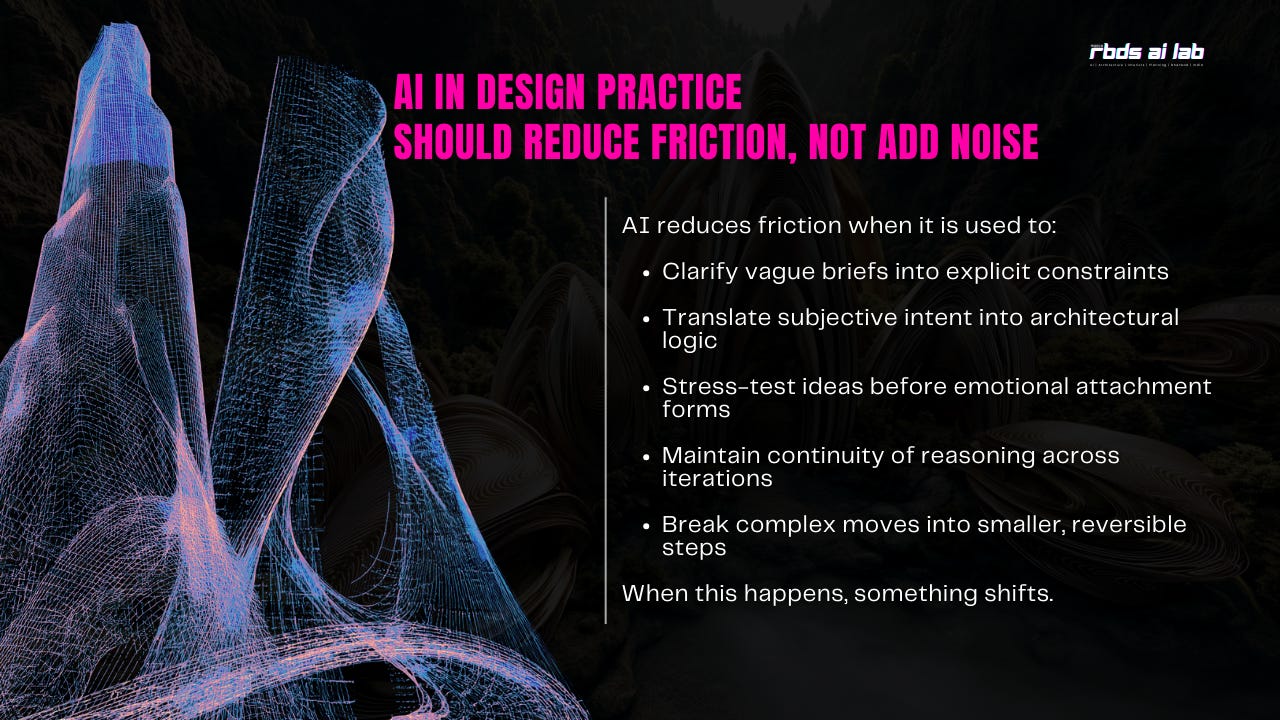
The architect spends less time recalling what was decided and more time deciding what matters.
This work is not glamorous. It does not produce instantly shareable images. But it produces architecture that holds up under pressure.
The illusion of the single-step solution
One of the most persistent misunderstandings around AI is the belief that a single prompt should solve a complex spatial problem.
A mood reference exists. An existing space exists. The expectation is simple: apply one to the other.
This is where friction quietly returns.
Spatial transformation is not a single operation. It is layered, sequential, and conditional. AI does not collapse this reality. It exposes it.
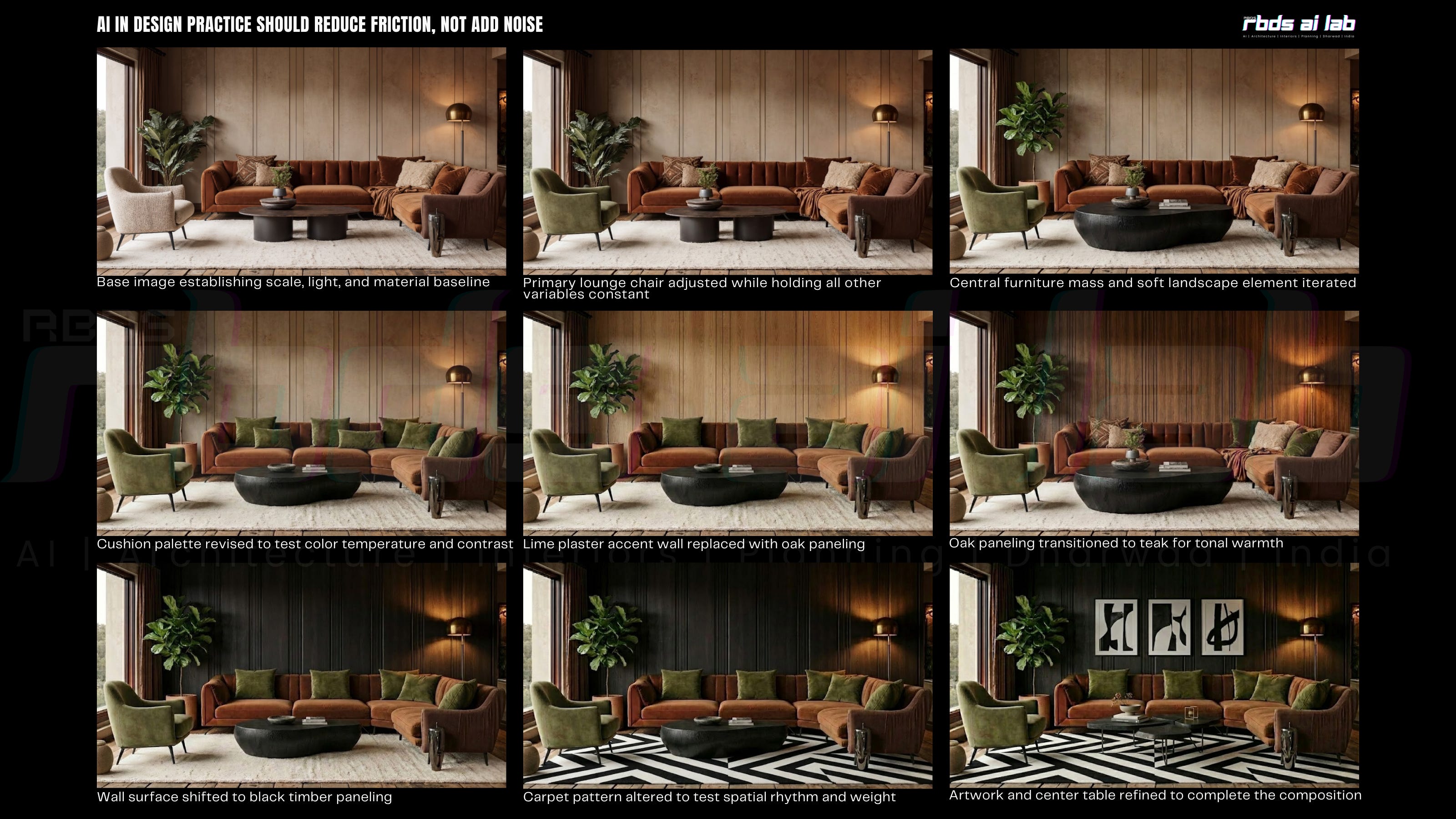
Trying to force everything into one step usually results in outputs that look convincing at first glance and unusable at second glance.
The mistake is not technical. It is procedural.
Iteration is not a failure of the tool
AI workflows that actually work tend to mirror how architects already think, but with less drag.
Instead of one large leap, they move in layers.
One element at a time. One decision at a time.
Structure before surface. Geometry before material. Light before texture. Proportion before atmosphere.
Each pass is partial by design. Each iteration clarifies what the next one should address.
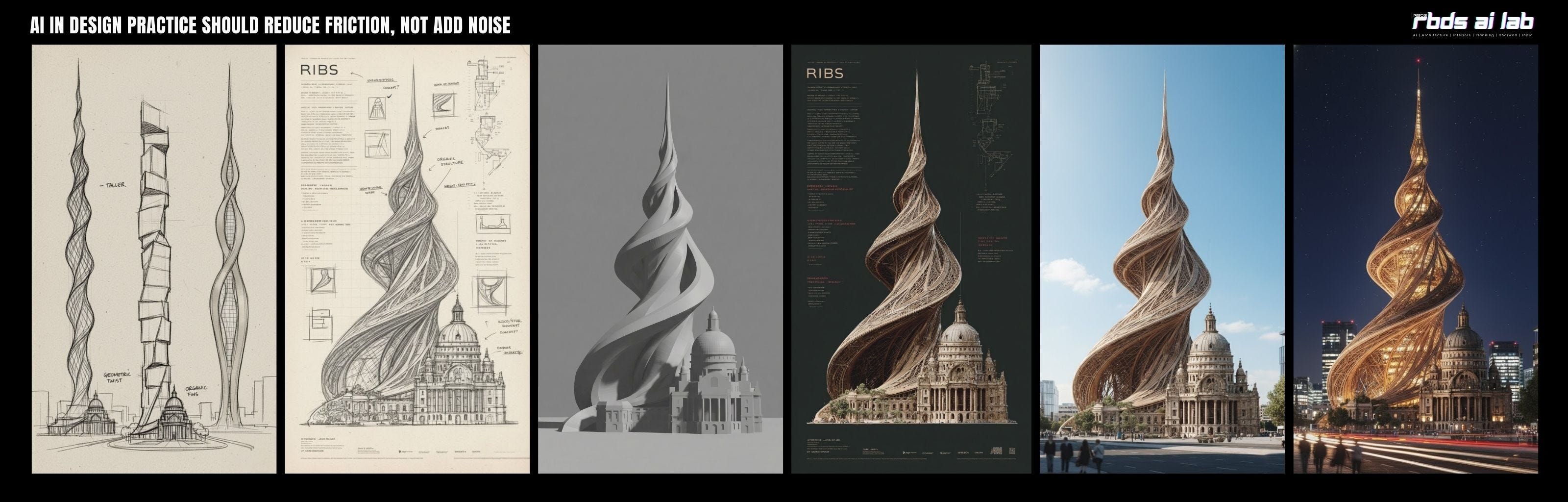
When AI is used this way, iteration stops feeling like inefficiency and starts functioning as control.
The noise comes from skipping layers, not from moving through them.
Tools are not interchangeable, and pretending they are creates friction
Not all AI systems think in the same way, and pretending otherwise is a fast way to generate confusion.
Some systems respond best to dense, explicit instructions. They thrive on specificity and structure.
Others work through dialogue. They refine intent through conversation rather than declaration.
When the wrong kind of instruction is forced onto the wrong kind of system, the result feels unpredictable, even unreliable.
This is not a limitation of AI. It is a misunderstanding of roles.
Usable workflows emerge when tools are chosen for how they reason, not how impressive their output looks.
Why AI fails most dramatically at the last minute
There is a common pattern behind most frustrations with AI.
It appears when AI is introduced only at the end of a project, under pressure, with little prior engagement.
At that point, there is no shared language, no internal logic, no accumulated context.
AI does not compensate for missing thinking. It amplifies whatever structure already exists.
This is why regular use matters.
Not because it makes you faster, but because it trains you to understand where each system fits, what it can be trusted with, and where human judgment must remain final.
When that understanding is in place, AI can reduce friction even under pressure.
Without it, no tool will save the moment.
Students and practitioners make the same mistake at different speeds
Students often misuse AI by chasing polish before understanding.
Practising architects misuse AI by chasing efficiency before clarity.
The error is identical. Only the consequences differ.
In both cases, AI becomes a shortcut around thinking rather than a scaffold for it.
And in both cases, the result is fragile work.
Usable workflows are boring by design
A usable AI workflow is rarely impressive from the outside.
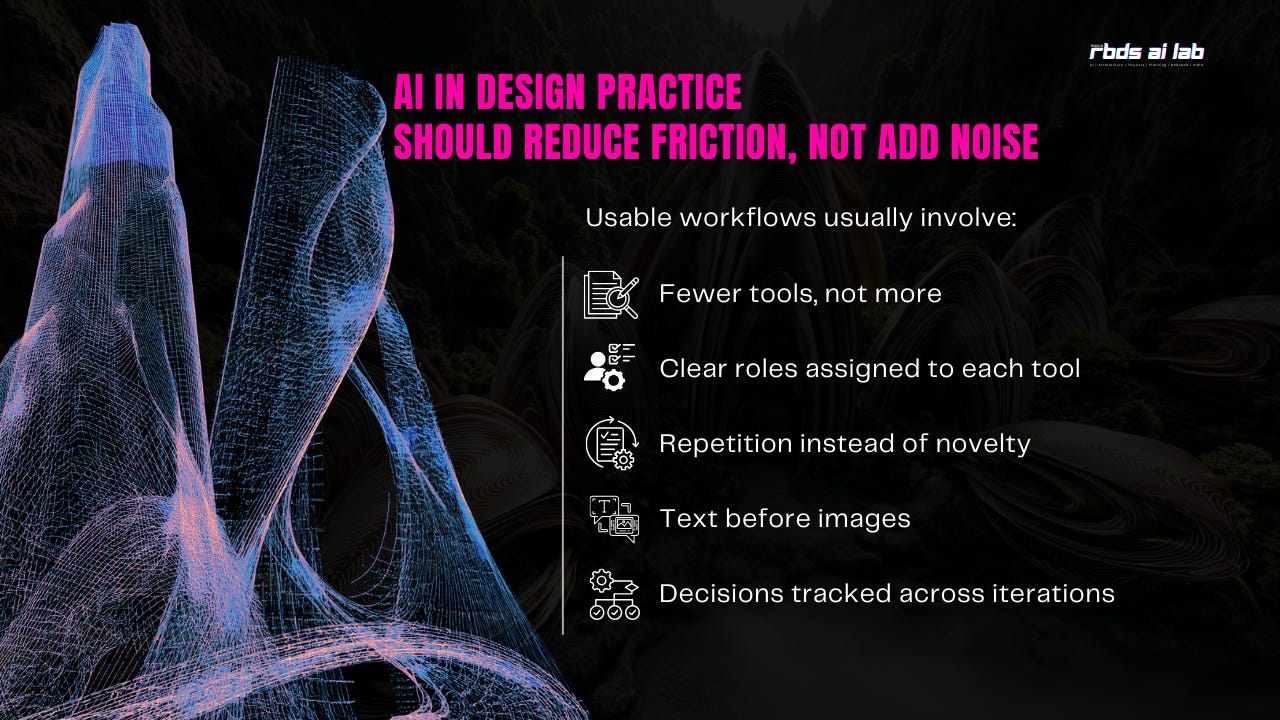
This kind of workflow does not photograph well. It does not trend.
It does, however, survive real constraints.
The uncomfortable truth
AI will not make architects better.
It will make their thinking more visible.
Those who already work with clarity, structure, and intent will feel relief. Less friction. Less noise.
Those who rely on ambiguity or momentum will feel exposed.
This is why the conversation so often returns to images. Visuals feel safer than reasoning.
Why this matters now
When convincing output becomes abundant, discernment becomes the scarce skill. For architects and designers, this is not an abstract shift—it plays out daily in studios, reviews, and client meetings.
AI does not remove responsibility from the architect. It concentrates it. When options multiply, and images arrive fully formed, the real question is no longer whether something looks right, but whether the decisions behind it are sound, intentional, and defensible.
Used well, AI does not resolve this tension for us. It sharpens it. It makes weak assumptions visible and forces clarity where ambiguity once passed unnoticed.
This is not a call to reject AI. It is a call to use it deliberately.
Reduce friction in how you think and work. Resist noise in how you decide and present. Build workflows that support judgment, not just output.
This line of thinking will continue. We’re working on something that explores how architects and designers can build usable AI workflows without adding noise.
The gap between those who generate and those who direct is widening. To navigate this shift, we need to stop reacting to tools and start commanding them. We have designed a physical immersion to bridge this exact divide.
We are bringing this to you as a comprehensive 1-day session. The framework is ready, and we are preparing to accept the first round of participants. Registrations for the Bengaluru Edition will go live shortly—stay tuned to this space and our socials so you don’t miss the window.
I’m Sahil Tanveer of the RBDS AI Lab, where we explore the evolving intersection of AI and Architecture through design practice, research, and public dialogue. If today’s post sparked your curiosity, here’s where you can dive deeper:
Read my book – Delirious Architecture: Midjourney for Architects, a 330-page exploration of AI’s role in design → Get it here
Join the conversation – Our WhatsApp Channel AI in Architecture shares mind-bending updates on AI’s impact on design → Follow here
Learn with us – Our online course AI Fundamentals for Lighting Designers is power-packed with 17+hrs of video content through 17 lessons → Enroll Here
Explore free resources – Setup guides, tools, and experiments on our Gumroad
Watch & listen – Our YouTube channel blends education with architectural art
Discover RBDS AI Lab – Visit our website
Speaking & events – I speak at conferences and universities across India and beyond. Past talks here
📩 Enquiries: sahil@rbdsailab.com | Instagram
Spot-on take here. The part about iteration as control rather than inefficiency really nails something thats been bugging me in AI discussions. Most people treat multiple passes like the tool is failing them, when really its just exposing that good design has always been layered. Working thru spatial problems sequentially isnt a limitation, its just more honest than pretending a single promt can handle everyhting at once.