

The AI Design Director Protocol
A Practical Framework for Directing AI in Architecture and Interiors

A Quiet Crisis in Practice
Clients don’t come to us with briefs anymore.
They come with images.
Pinterest boards. Instagram reels. AI-generated fantasies forwarded on WhatsApp with a single sentence: “Something like this.”
At first glance, this feels harmless—maybe even helpful. But beneath the surface, it is quietly corroding architectural practice.
Those images are not neutral references. They are expectation-setting devices.
They promise gravity-defying spans, impossible material junctions, contradictory lighting conditions, and budgets that only exist in pixels. And once a client has emotionally attached themselves to an image, no amount of technical explanation feels convincing enough.
This is not an aesthetic problem.
It is a professional risk.
AI did not create this crisis. It accelerated it.
For the first time, clients can generate “architecture” faster than studios can reason through it. Output has become abundant. Judgment has become scarce.
And that is why this moment matters.
To respond to this shift, we have developed a structured intervention for practising architects and designers—a disciplined framework designed to convert image-driven chaos into decision-led architectural thinking.
The Real Enemy Is Not AI
There is a lot of noise about architects being replaced by machines.
That fear is misplaced.
What is actually happening is far more subtle—and far more dangerous.
AI is behaving like the most talented intern you have ever hired.
Fast. Tireless. Visually impressive.
And completely indifferent to structure, budget or human use.
Left unmanaged, this intern does exactly what interns do: it over-promises, improvises recklessly, and hallucinates confidence.
The damage does not show up immediately.
It shows up during coordination.
During value engineering.
During client approvals.
During execution.
Studios lose weeks trying to “fix” images that should never have entered the workflow in the first place.
The real enemy is not AI.
It is undirected AI.
From Prompting to Directing
Most designers today are stuck in what can only be described as slot‑machine prompting—something that feels like progress, but isn’t.
Type a prompt. Generate four options. Regenerate. Upscale. Try again.
This feels productive. It looks impressive.
But it is intellectually hollow.
When everything is possible, nothing is accountable.
What is missing is not better prompts.
What is missing is authorship.
Architecture has always been about decision-making—knowing what to include, what to reject, and what to defend.
AI does not remove that responsibility.
It concentrates it.
If AI is the intern, the architect must become the Director.
What is needed now is not another tutorial, but a system—a framework that restores authorship and accountability to the architect.
That framework is what we call The AI Design Director Protocol.
The AI Design Director Protocol
The AI Design Director Protocol is a decision‑led framework for working with generative systems inside real architectural practice.
It does not teach you how to use AI.
It teaches you how to direct it.
The protocol is organised as a deliberate sequence of thinking—each stage solving a specific failure that studios are currently experiencing.
The sequence is simple, but not simplistic:
Diagnose → Reason → Direct → Refine → Synthesize → Systemize
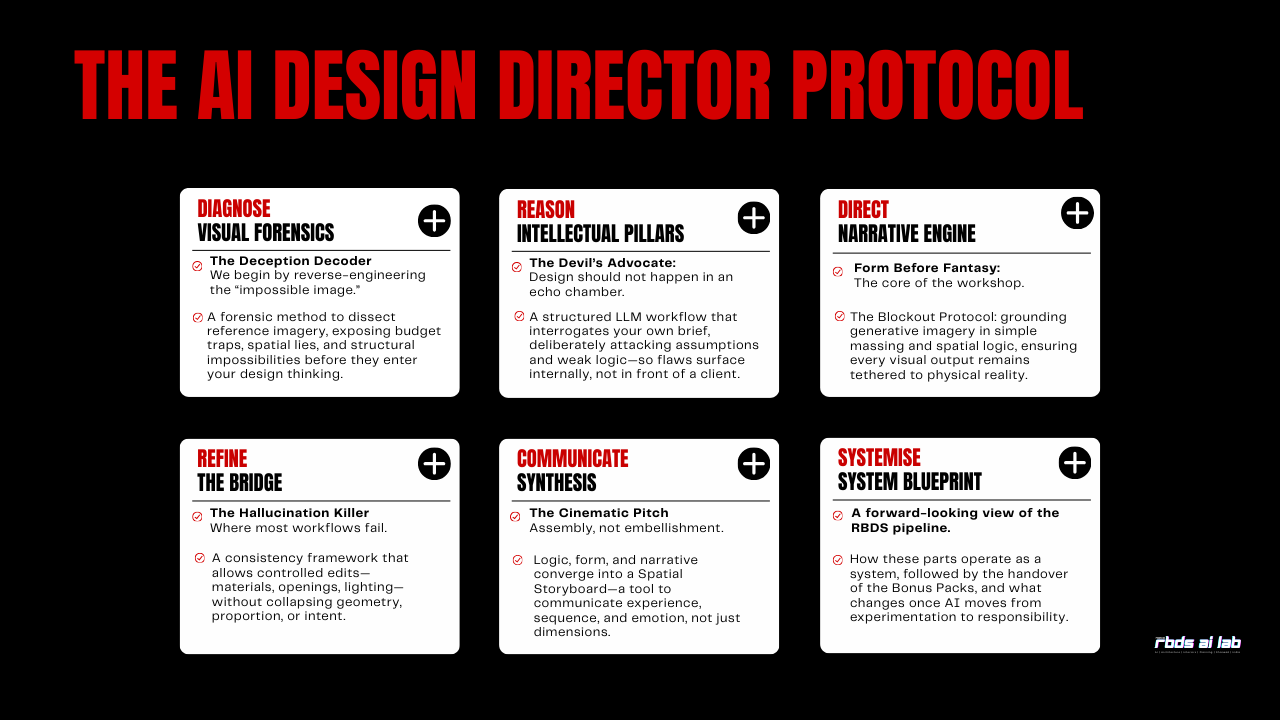
What follows is not a tutorial, but an explanation of the framework itself.
1. Visual Forensics (Diagnose)
Every project today begins with images. The protocol begins by refusing to trust them.
Visual Forensics treats images as evidence, not inspiration.
Instead of asking “Do we like this?” the architect asks:
What would fail first if we tried to build this?
Structure, material behaviour, lighting logic, constructability—these are interrogated before any design direction is accepted.
AI is used here not as a generator, but as a critic—helping surface risks, contradictions, and physical impossibilities embedded in seductive visuals.
This stage exists to stop fantasy from entering the design bloodstream.
2. Intellectual Pillars (Reason)
Most projects do not collapse because of form. They collapse because of unclear direction.
Clients rarely give briefs. They give noise.
Contradictory desires. Half‑formed aspirations. Vibes masquerading as requirements.
This stage converts noise into structure.
Briefs are clarified, then deliberately attacked—from the perspective of construction, use, circulation, and conceptual rigor.
This is where assumptions are challenged internally, rather than failing publicly.
Design does not begin here.
Alignment does.
3. Narrative Engine (Direct)
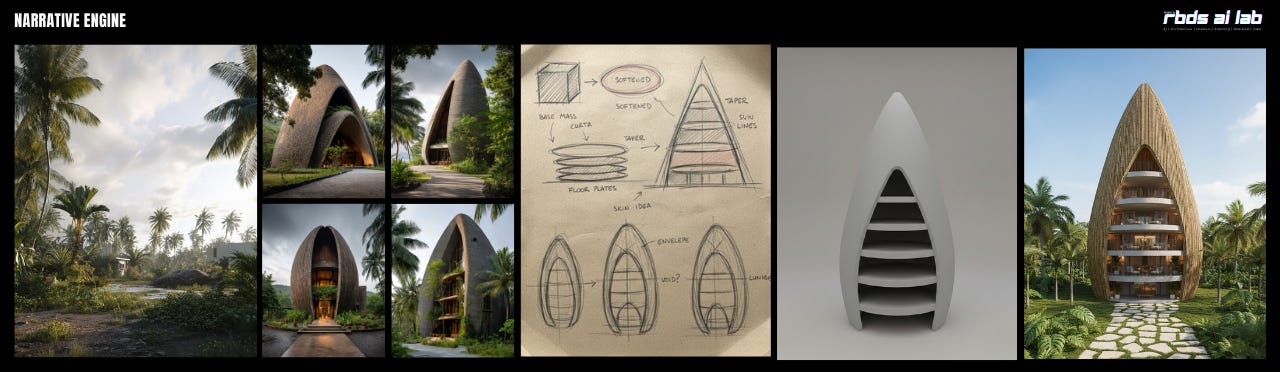
Uncontrolled generation leads to drifting geometry and incoherent proposals.
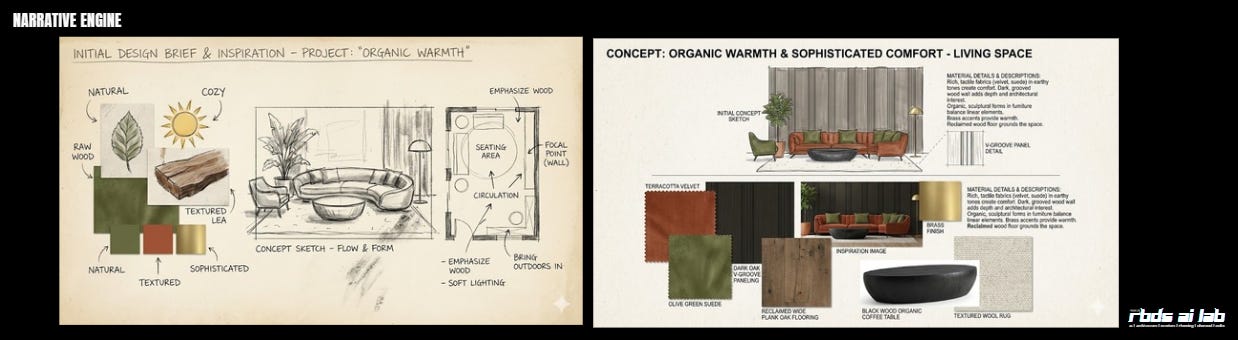
The protocol prevents this by separating atmosphere from geometry.
Mood is developed independently.
Massing is anchored deliberately.
Only once both are clear are visuals allowed to emerge.
This stage restores a fundamental architectural truth: form is directed, not discovered by accident.
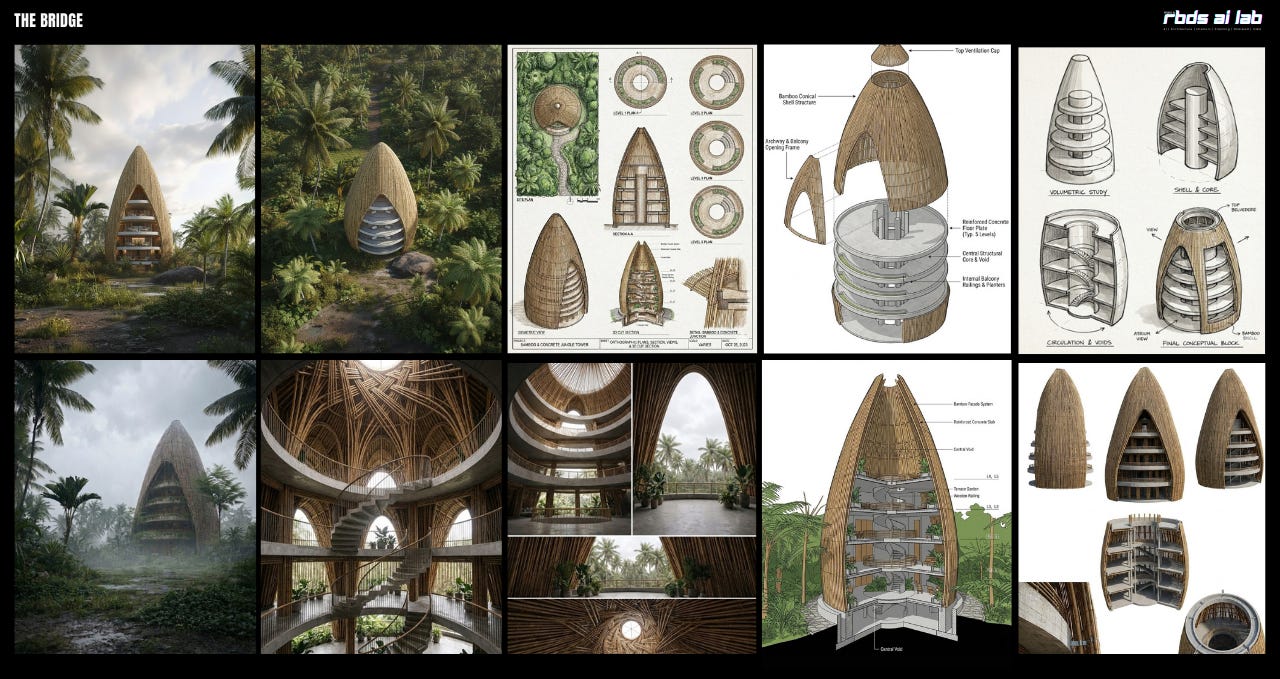
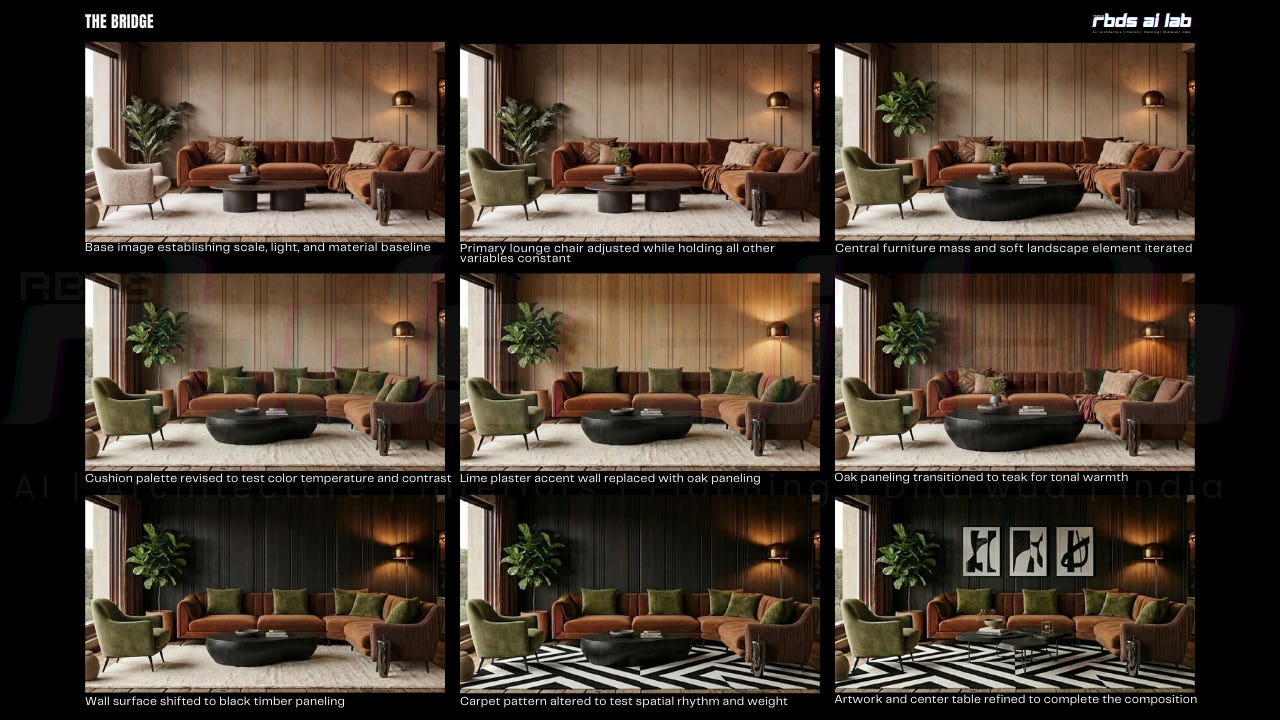
4. The Bridge (Refine)
This is where most AI workflows fail.
Refinement collapses structure. Edits destroy intent. Consistency breaks.
The Bridge stage introduces controlled refinement—materials, lighting, props, context—without collapsing geometry or proportion.
Architecture and interiors may diverge in execution, but they remain coherent in logic.
Refinement becomes surgical, not destructive.
5. Synthesis (Communicate)
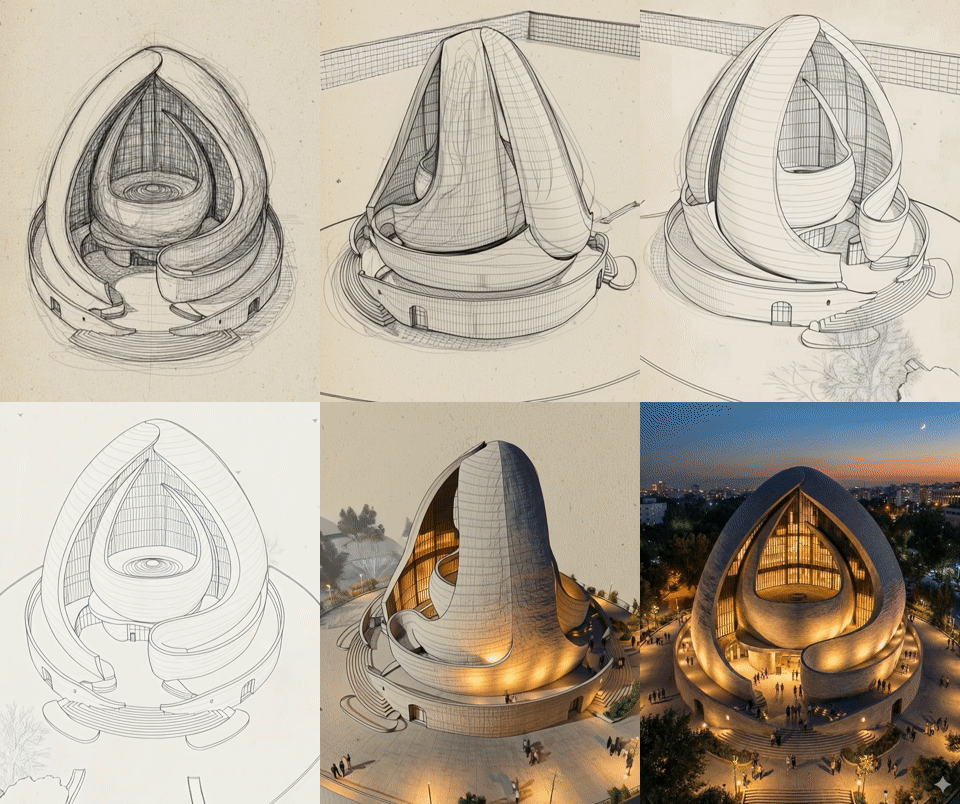
Architecture is approved emotionally, not technically.
This stage assembles logic, form, and atmosphere into a single narrative artefact—designed for how clients actually consume information today.
Not frozen renders.
Not scattered PDFs.
A clear, legible story that communicates intent rather than overwhelms with output.
6. System Blueprint (Systemise)
Practices cannot survive on heroics.
This final stage zooms out—showing how the protocol scales from individual projects to studio systems.
Templates. Pipelines. Roles.
AI stops being a personal skill.
It becomes infrastructure.
Consistency replaces dependency.
Learning the Protocol (Field Testing Begins)
Frameworks are only valuable when they survive reality.
We are now teaching this protocol in its applied form—working through real decision‑making, not hypothetical demos.
The first field‑testing environment for the AI Design Director Protocol will be Bengaluru.
This is a full‑day, in‑person working session.
Not a lecture.
Not a recording.
A room where architects and designers actively practice directing AI rather than reacting to it.
The Hallucination Ends Here
Clients will continue to bring images.
AI will continue to generate faster than we can think.
The question is no longer whether we use these systems.
The question is whether we direct them—or let them direct us.
If you are ready to move from output‑chasing to decision‑making, we are opening the protocol to a limited group for its first public application.
THE AI DESIGN DIRECTOR PROTOCOL
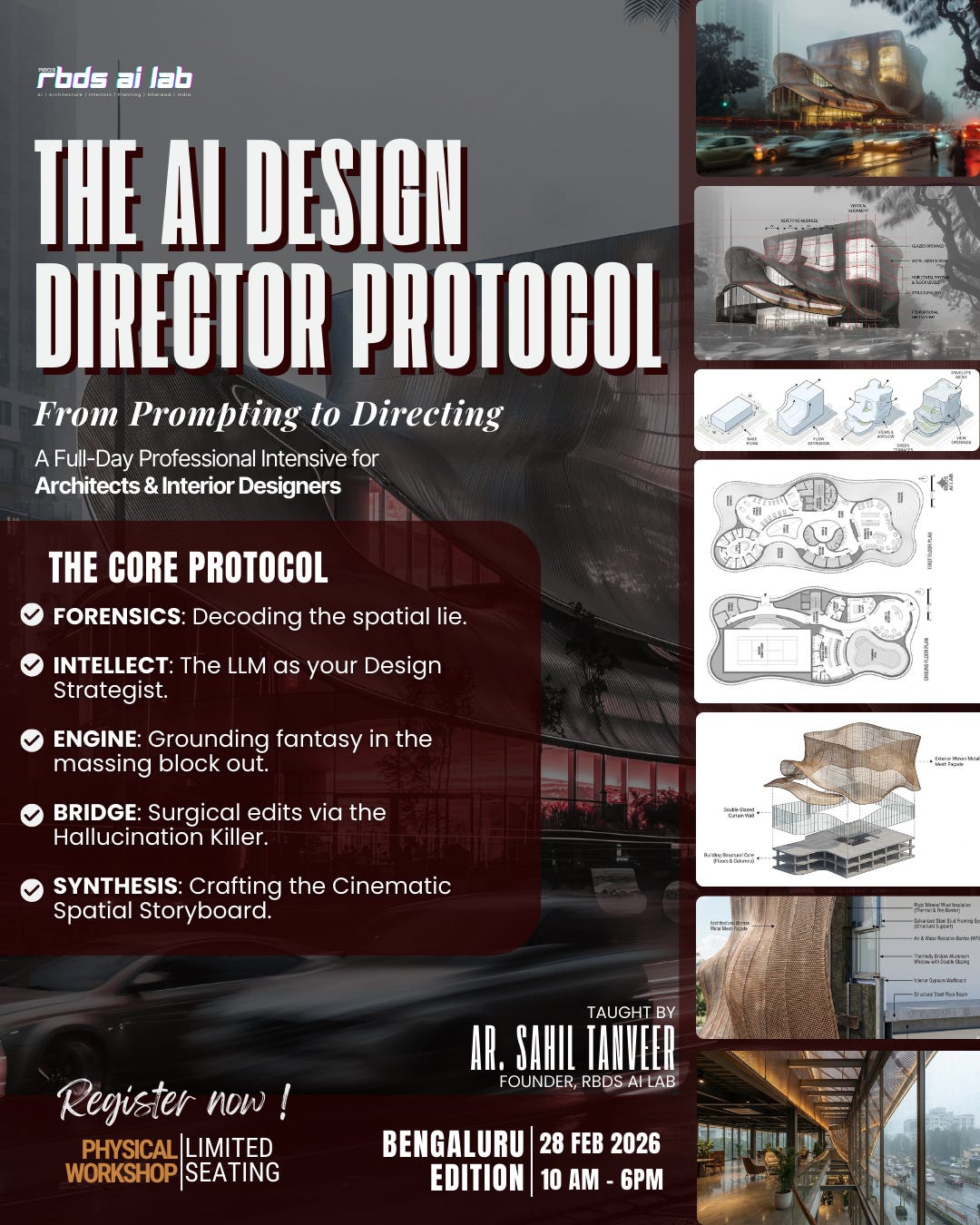
📍 Bengaluru
🗓️ February 28, 2026
🕙 10:00 AM – 6:00 PM
⚠️ Limited seats. In‑person only.
Stop collecting images.
Start directing reality.
I’m Sahil Tanveer of the RBDS AI Lab, where we explore the evolving intersection of AI and Architecture through design practice, research, and public dialogue. If today’s post sparked your curiosity, here’s where you can dive deeper:
Read my book – Delirious Architecture: Midjourney for Architects, a 330-page exploration of AI’s role in design → Get it here
Join the conversation – Our WhatsApp Channel AI in Architecture shares mind-bending updates on AI’s impact on design → Follow here
Learn with us – Our online course AI Fundamentals for Lighting Designers is power-packed with 17+hrs of video content through 17 lessons → Enroll Here
Explore free resources – Setup guides, tools, and experiments on our Gumroad
Watch & listen – Our YouTube channel blends education with architectural art
Discover RBDS AI Lab – Visit our website
Speaking & events – I speak at conferences and universities across India and beyond. Past talks here
📩 Enquiries: sahil@rbdsailab.com | Instagram