

The Architect as Systems Thinker
AI as Cognitive Infrastructure in Architectural Practice + The Frankfurt update

Moving the Conversation Beyond Tools
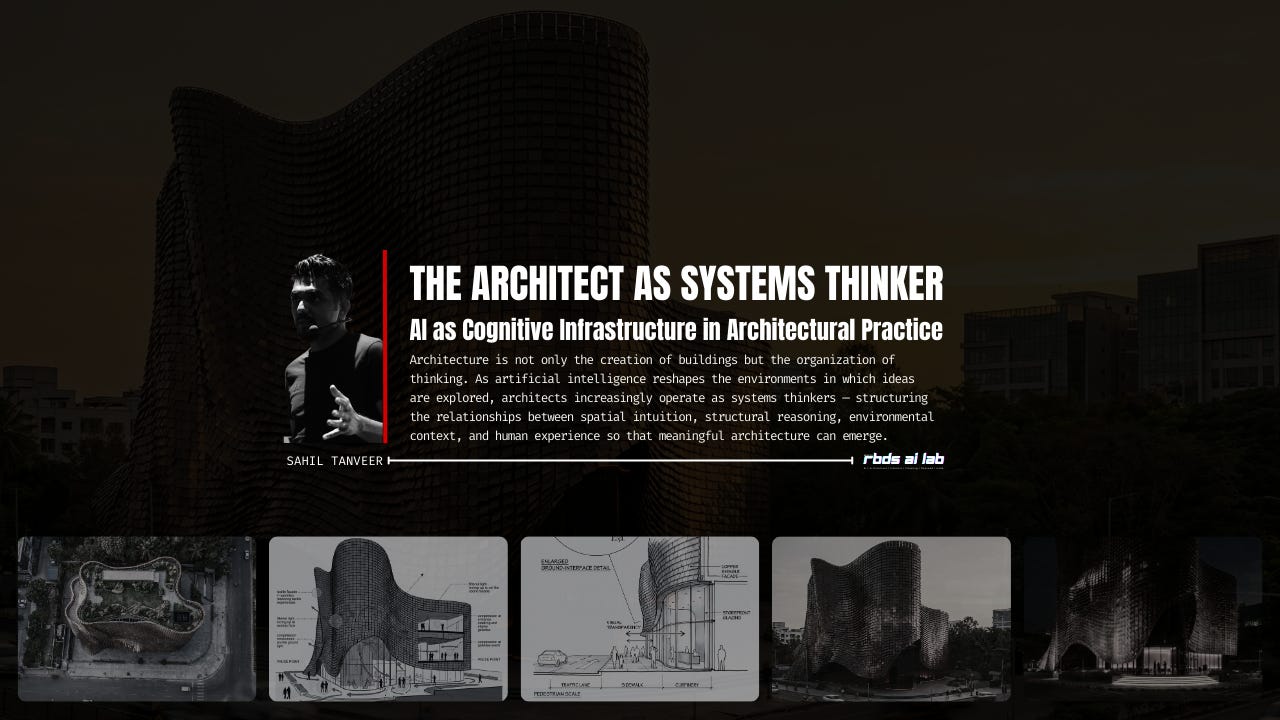
Over the last few years, most conversations about artificial intelligence in architecture have revolved around tools. Architects compare image generators, discuss rendering pipelines, or experiment with automated workflows. These discussions are understandable because new technologies always arrive through software. Yet focusing only on tools risks missing the deeper transformation taking place.
Artificial intelligence is not simply another instrument added to the architectural toolkit. The more significant shift is cognitive. AI changes the environment in which architectural thinking happens. It reorganizes how ideas are explored, tested, refined, and communicated.
To understand this shift properly, it is helpful to step back and place artificial intelligence within the longer historical evolution of architectural thinking.
The Evolution of Architectural Thinking Infrastructures
Architecture has always developed alongside the mediums that support thinking. These mediums do not merely record ideas; they actively shape how architects reason about space, structure, and experience.
In earlier periods, architectural knowledge was transmitted through oral traditions and apprenticeships. Builders learned by observation, repetition, and embodied practice. Drawings later externalized spatial thinking, allowing architects to manipulate geometry on paper before construction began. Measured drawings and plans introduced precision and coordination across complex projects. Digital modeling and parametric systems further expanded the architect’s capacity to explore rule-based design environments. Each of these shifts altered how architects approached design problems.
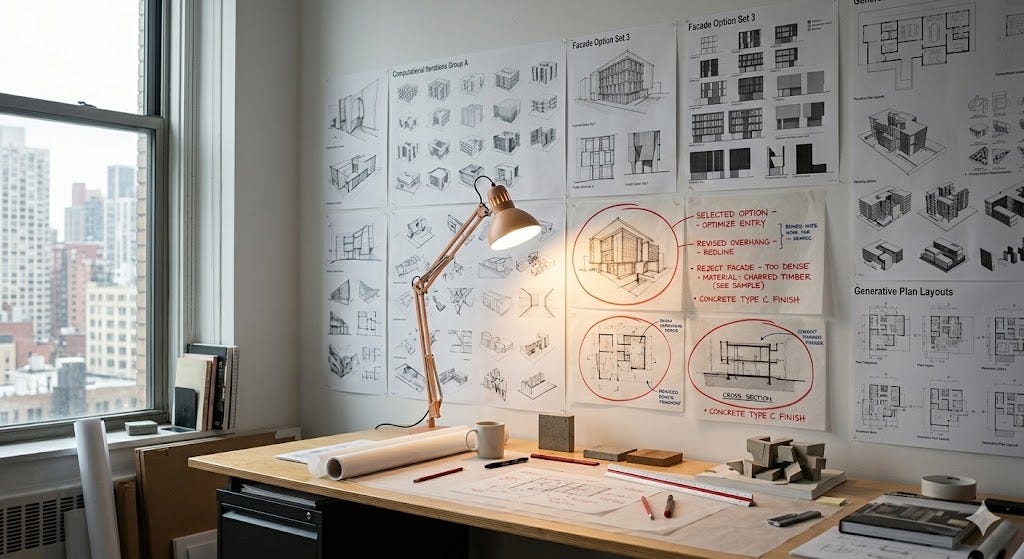
Artificial intelligence should be understood as the next stage in this lineage. It is not simply another representation tool like CAD or BIM. Instead, it functions as cognitive infrastructure — a medium that allows architects to interrogate problems, generate structured reasoning, and explore large decision spaces.
Recognizing this distinction changes how we think about the role of the architect.
From Designing Objects to Designing Decision Systems
Architectural education traditionally focuses on the production of objects. Students are trained to produce drawings, models, facades, and spatial compositions. These outputs remain central to the discipline, but contemporary projects increasingly operate within complex networks of information.
Urban conditions, climate data, building systems, regulatory constraints, financial structures, and social behaviors interact simultaneously within a project. In this environment, architectural work begins to resemble the organization of systems rather than the production of isolated objects.
Artificial intelligence intensifies this shift. Large language models, generative systems, and analytical tools allow architects to explore broader decision spaces than previously possible. Instead of producing a single proposal, architects can construct frameworks that test multiple strategies across spatial, environmental, and economic parameters.
In this context, the architect’s role expands toward designing decision systems. The architect defines constraints, establishes evaluation criteria, and structures how different forms of intelligence contribute to the evolution of the project.
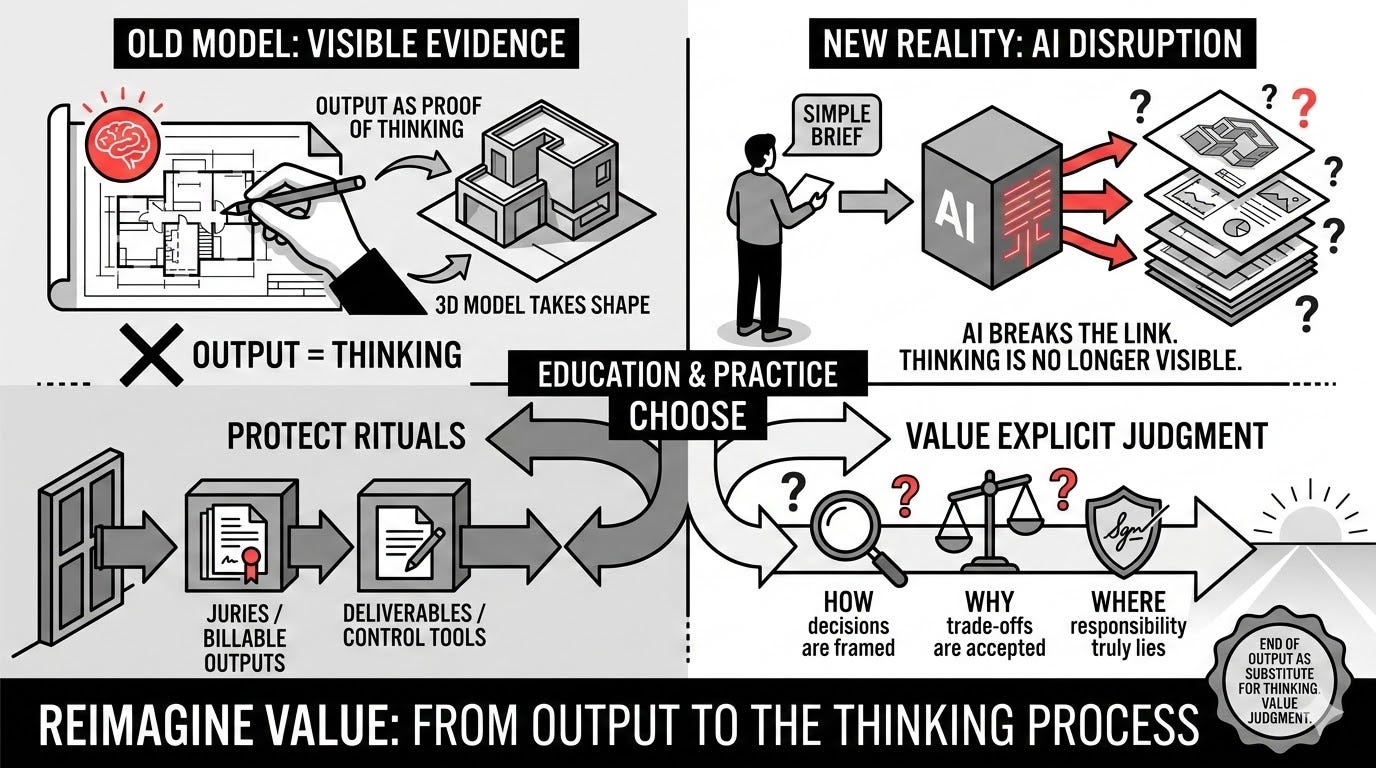
The building remains important, but it becomes the outcome of a larger reasoning structure.
Rethinking Authorship in an AI-Augmented Practice
One of the most common concerns surrounding artificial intelligence is the question of authorship. If machines participate in generating ideas, does architectural authorship weaken or disappear?
A closer examination of architectural practice suggests that authorship has never depended on manual production alone. Architects rarely fabricate every component of a building themselves. Construction teams, engineers, consultants, and craftsmen all contribute to the realization of a project. Architectural authorship has historically been located in judgment.
Architects decide which ideas deserve development, which constraints are negotiable, and which design directions carry long-term consequences. These decisions shape the identity of the project even when many actors participate in its realization.
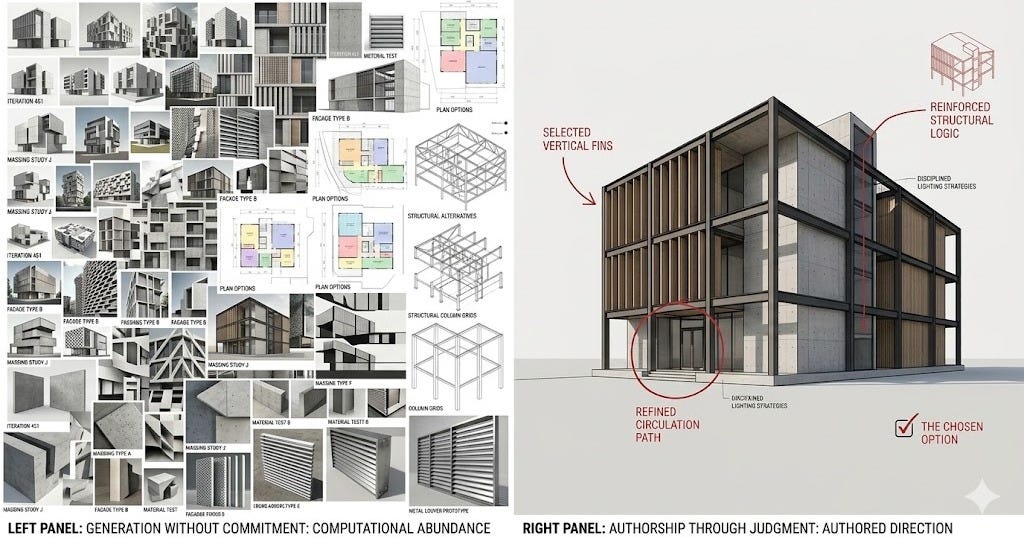
Artificial intelligence does not remove this responsibility. On the contrary, it intensifies it. When computational systems can generate hundreds of variations, the architect must exercise stronger judgment to identify meaningful directions. The responsibility for selecting, refining, and committing to decisions becomes even more concentrated.
In this sense, authorship does not disappear in an AI-assisted environment. It relocates from production toward direction.
Architecture as an Interface Between Forms of Intelligence
Architecture has always mediated between multiple forms of knowledge. Structural logic, environmental performance, human perception, economic feasibility, and cultural meaning all influence the design process.
Artificial intelligence introduces an additional form of reasoning into this network. Computational systems can process large datasets, simulate environmental behaviour, or explore generative possibilities that extend beyond traditional manual exploration.
The role of the architect therefore, becomes that of an interface designer between different intelligences. Human intuition, cultural understanding, technical expertise, and computational reasoning must be aligned into coherent spatial outcomes.
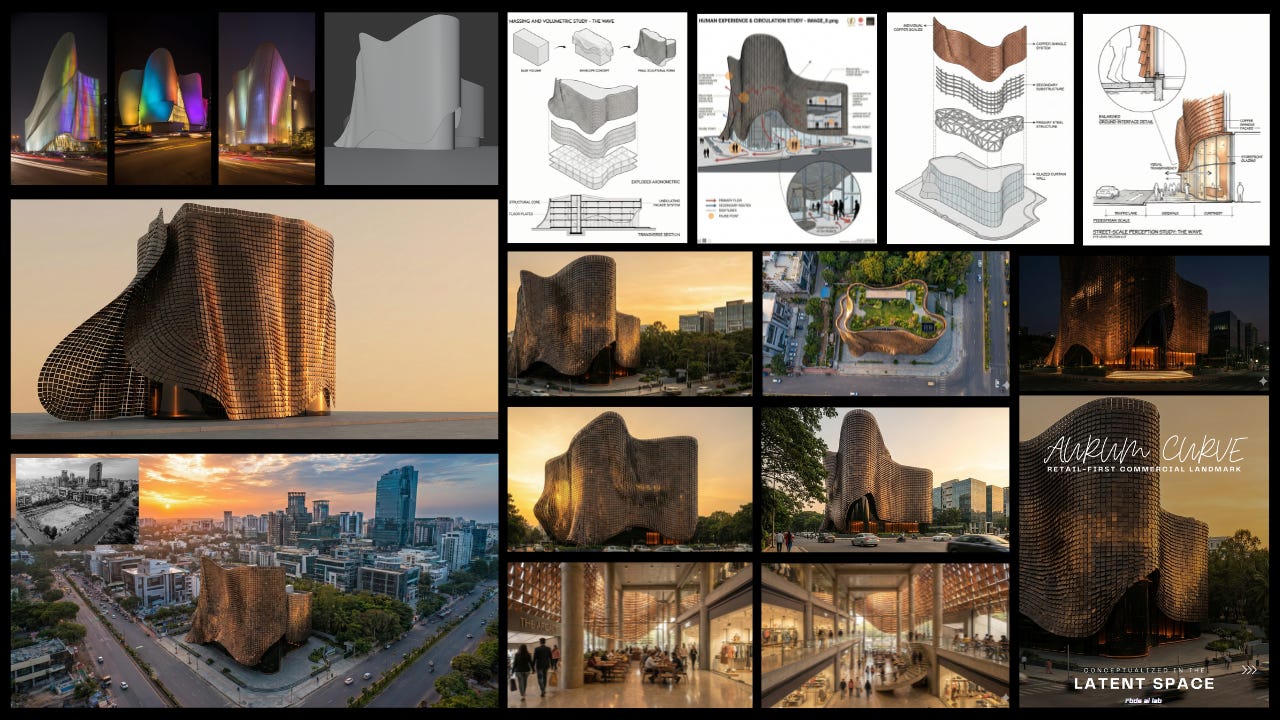
Architecture does not become less human in this process. Instead, the discipline becomes more explicit about the negotiation that has always existed between different systems of knowledge.
Artificial intelligence simply makes this negotiation more visible and more structured.
Designing the Thinking Framework Behind Buildings
As AI-assisted workflows mature, an important realisation emerges. Buildings themselves are only one layer of the architectural project. Behind every building lies a network of questions, assumptions, simulations, and decisions that shape the final outcome.
Artificial intelligence allows architects to interact directly with this cognitive layer.
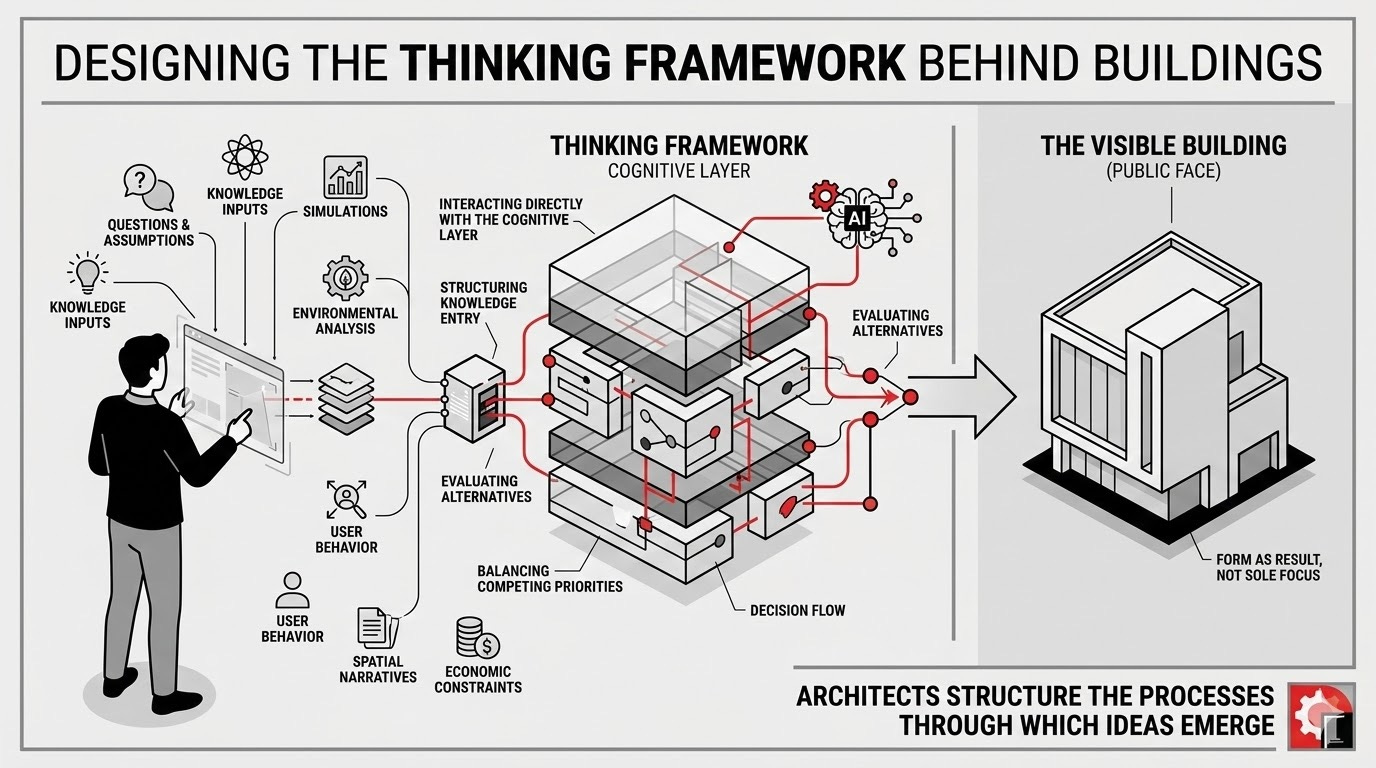
Instead of focusing exclusively on form generation, architects can structure how knowledge enters the design process, how alternatives are evaluated, and how competing priorities are balanced. Environmental analysis, user behavior, spatial narratives, and economic constraints can all be incorporated into a broader thinking framework.
Future architectural practice will increasingly involve designing these thinking frameworks. Architects will structure the processes through which ideas emerge rather than focusing solely on the final formal result.
The visible building will remain the public face of architecture, but the intellectual project will increasingly reside in the systems that produce it.
Responsibility in a Systems-Oriented Discipline
The expansion of architectural thinking into systems does not reduce the responsibility of the architect. In many ways, it increases it.
When architects design the systems through which decisions are generated, the consequences of those systems scale across entire projects. Poorly structured decision environments produce confusion, inefficiency, and superficial outcomes. Well-designed systems produce clarity, resilience, and meaningful spatial solutions.
The architect as systems thinker therefore carries a dual responsibility. One responsibility remains spatial: shaping environments that support human life and cultural expression. The second responsibility becomes cognitive: designing the frameworks through which complex design problems are understood and resolved.
Artificial intelligence magnifies both responsibilities.
The Next Stage of Architectural Thinking
The current discourse around AI in architecture often emphasizes novelty. New rendering capabilities, faster visualizations, or automated workflows dominate many discussions. While these developments are valuable, they represent only the surface of a larger transformation.
The deeper shift lies in how architects organize thinking.
When artificial intelligence is understood as cognitive infrastructure rather than a tool, the architect’s role becomes clearer. Architects do not compete with machines to produce ideas. Instead, they design the intellectual environments in which ideas emerge, interact, and evolve into architecture.
Seen from this perspective, the future of architectural practice is not defined by machines replacing architects. It is defined by architects becoming more capable organizers of complexity.
In that sense, the architect as systems thinker is not a futuristic identity. It is the next logical extension of what the discipline has always been attempting to do.
~end~
The Frankfurt Update

This week I was meant to be in Frankfurt speaking at the Future Forum at Light + Building, invited by the wonderful people at the Virtual Lighting Design Community through Martin Klaasen. The plan was simple: stand on stage, speak about AI, architecture, lighting design, and the strange moment our discipline finds itself in—where images travel faster than ideas, and where beauty can now be generated in seconds. But the world has its own plans. With the sudden closure of Middle Eastern airspace due to the ongoing conflict, the journey from India to Frankfurt became near impossible. Martin kindly suggested that I record my presentation so it could still be played at the venue. But if you have ever attended one of my talks, you know they are not really “presentations.” They are closer to a performance—part lecture, part story, part provocation.
So instead of sending a recording, we did what our studio does best. We made a film. In five intense days, the girls of my studio and I—working straight through the weekend that also included Women’s Day—produced a short cinematic piece titled The Image and the Idea. The film reflects on a quiet shift happening in architecture: from the age of drawings and theory, to the age of seductive images, and now into the age of artificial intelligence. It asks a simple but uncomfortable question—when beautiful images are effortless, what remains valuable in design? Tomorrow, instead of my talk, the audience in Frankfurt will watch this film. For those of you who follow my work and believe in the strange intersection of architecture, storytelling, and technology that we are trying to build here, this film is a small expression of that larger journey. More soon.

I’m Sahil Tanveer of the RBDS AI Lab, where we explore the evolving intersection of AI and Architecture through design practice, research, and public dialogue. If today’s post sparked your curiosity, here’s where you can dive deeper:
Read my book – Delirious Architecture: Midjourney for Architects, a 330-page exploration of AI’s role in design → Get it here
Join the conversation – Our WhatsApp Channel AI in Architecture shares mind-bending updates on AI’s impact on design → Follow here
Learn with us – Our online course AI Fundamentals for Lighting Designers is power-packed with 17+hrs of video content through 17 lessons → Enroll Here
Explore free resources – Setup guides, tools, and experiments on our Gumroad
Watch & listen – Our YouTube channel blends education with architectural art
Discover RBDS AI Lab – Visit our website
Speaking & events – I speak at conferences and universities across India and beyond. Past talks here
📩 Enquiries: sahil@rbdsailab.com | Instagram