

The Hidden Layers — Compute, Energy, Labour, and the Bias You Will Reproduce in Built Form
Article 5 introduced training data as the technical foundation. This article returns to it as the ethical and political foundation — the part the architect cannot pretend not to know.

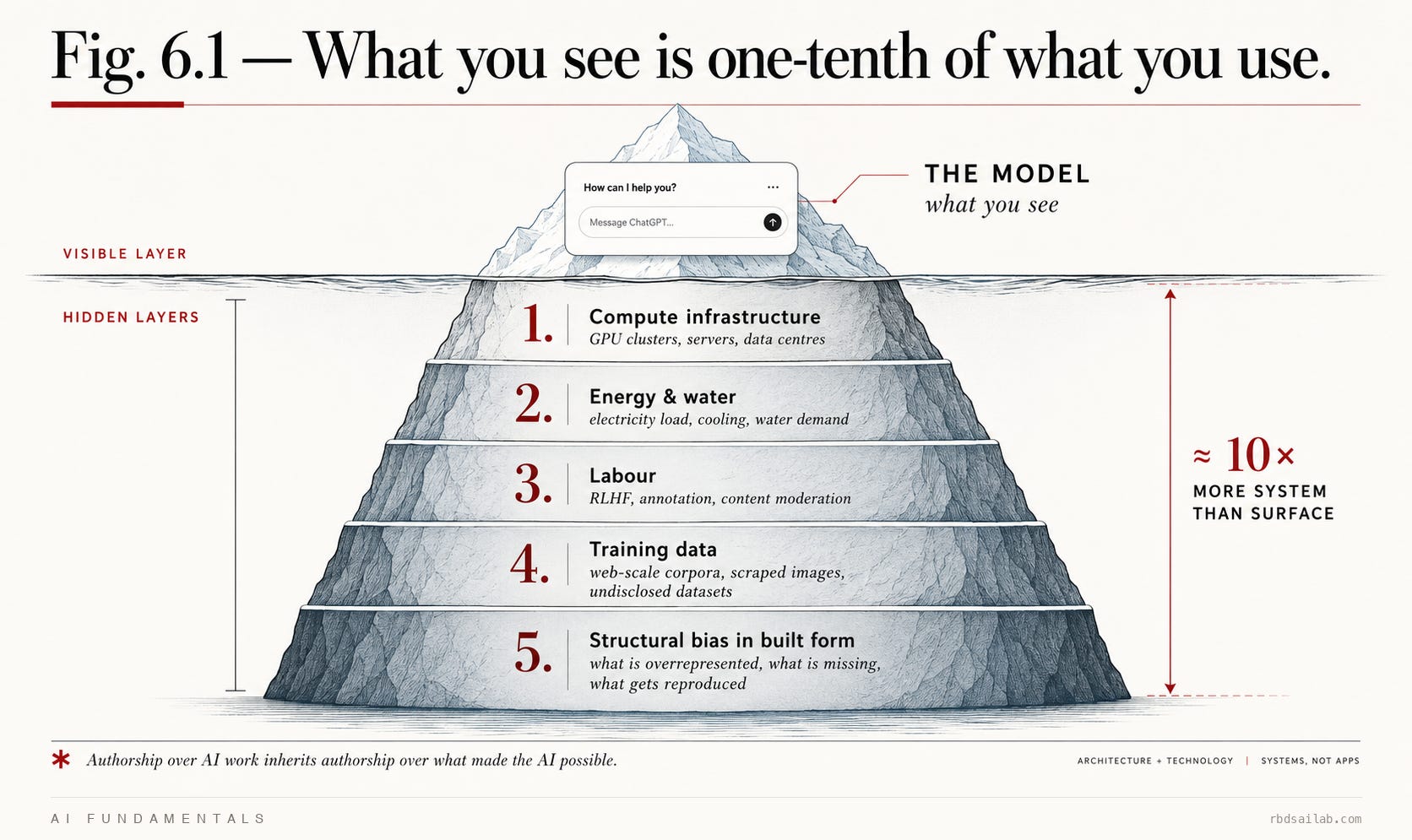
The model is the visible layer. Underneath it sits a stack the architect rarely looks at — compute infrastructure, energy and water demand, the human labour that made the model behave at all, and the training corpora that decide which buildings the model has seen often enough to become default. Design discourse treats this as someone else’s domain. It is not. Authorship over AI work inherits responsibility for the conditions that made the AI possible. The literacy here is not an ethical garnish on top of the technical literacy of Articles 1 through 5 — it is the same literacy continued one floor down.
Compute — what training a frontier model actually requires
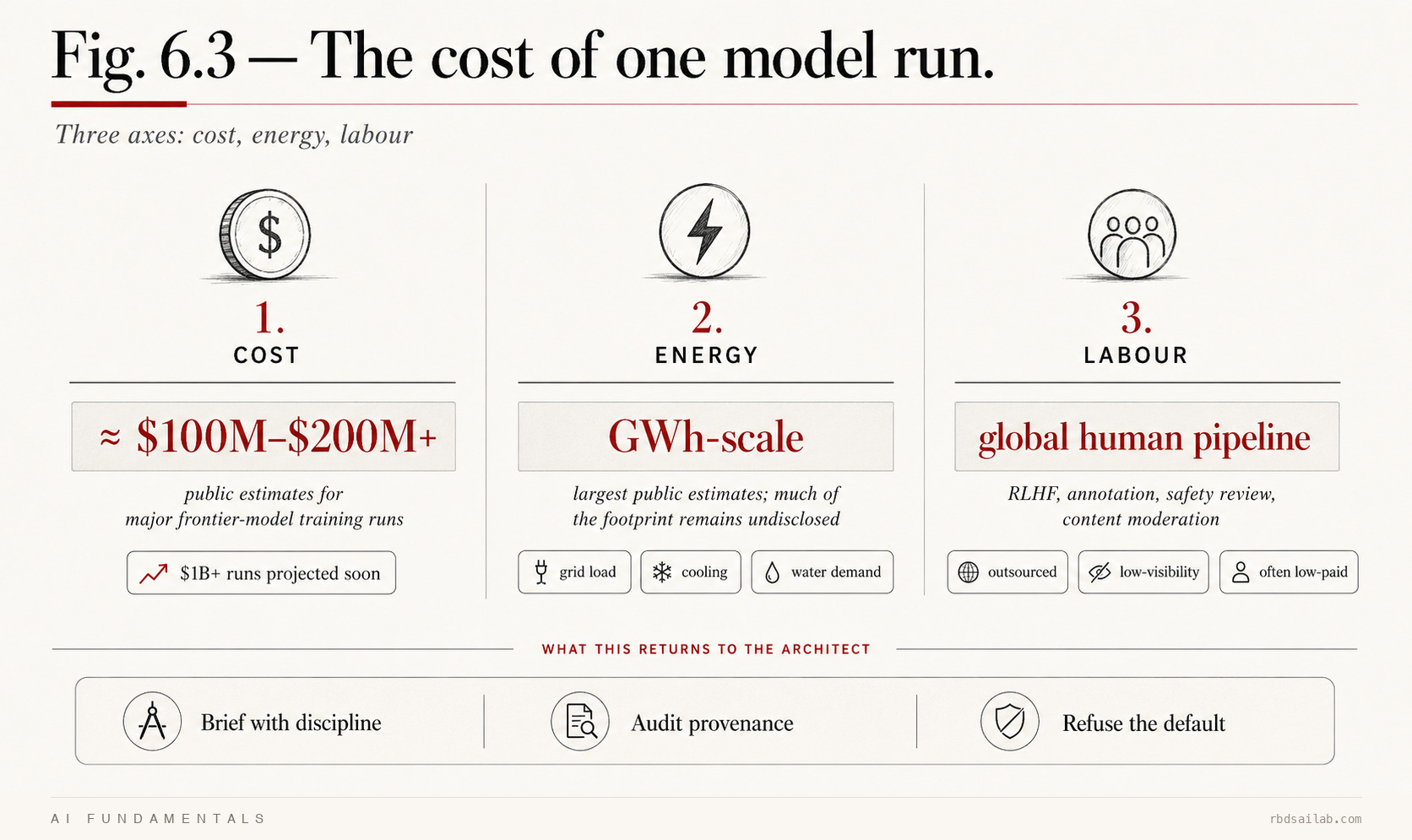
A frontier model in 2026 is not trained on a workstation. It is trained across industrial GPU or TPU clusters, usually for weeks or months, and the publicly visible examples already sit at the scale of tens of thousands of accelerators: Meta says Llama 3.1 405B was pushed across more than 16,000 H100 GPUs; Stanford’s 2025 AI Index, using Epoch AI estimates, places Llama 3.1 405B at about $170M and Gemini 1.0 Ultra at about $192M. Epoch’s broader cost model projects billion-dollar frontier training runs by 2027. These are estimates, not receipts. That qualification matters because the frontier companies now disclose less, not more.[1]
The model is trained in a small number of spectacular runs and then used at industrial scale. That is why inference — the ordinary act of asking, generating, revising, asking again — is now the live environmental problem. The small prompt is only small at the scale of the desk.[2]
Energy and water — the grid is now a designer’s concern
The IEA’s Energy and AI report (April 2025), read in an architectural register, feels like a planning document for a city whose infrastructure brief arrived late. Data centre electricity demand was about 415 TWh in 2024 and is projected to more than double to around 945 TWh by 2030; AI-focused and accelerated-server demand grows faster than conventional server demand. The 2026 IEA update sharpens the picture: global data centre electricity demand grew about 17% in 2025, while AI-focused data centres grew about 50%. The Patterns / Cell paper by Alex de Vries-Gao, published online in late 2025 and in the January 2026 issue, estimates AI’s 2025 carbon footprint at 32.6–79.7 million tons of CO2 and its water footprint at 312.5–764.6 billion litres, with disclosure gaps large enough that every number should be read as both an estimate and an indictment[2.][3]
Two registers matter here. Every visualisation, every iteration, every prompt is a small energy decision. And the data centre is a building — a power-dense, water-sensitive, politically contested building — increasingly briefed to architects, engineers, planners, and local authorities who must hold both its computational and environmental logic. A discipline that has argued for embodied-carbon literacy in concrete and steel cannot look away when the carbon moves into the wall socket.
The labour layer — RLHF and content moderation
A model does not become safe-to-use by accident. Between the raw pre-trained weights and the polished assistant the architect prompts sits a layer of human work — reinforcement learning from human feedback, RLHF — and a parallel layer of content moderation. Both are predominantly performed by annotators in Kenya, the Philippines, India, Nigeria, and Venezuela, paid roughly $1.32–$2 per hour, exposed to traumatic content as part of the safety pipeline. Billy Perrigo’s January 2023 Time investigation — The $2 Per Hour Workers Who Made ChatGPT Safer — documented the Sama / OpenAI Kenya contract.[4] Karen Hao’s Empire of AI (2025) extends the reporting across the Philippines, Chile, and Venezuela, framing the pattern as a continuation of older extractive economies rather than a glitch in a new one.[5]
For twenty years, design discourse has used supply chain transparency almost exclusively about materials — where the marble was quarried, who laid the brick, whether the timber was certified. AI has its own supply chain. The annotators are part of every prompt the studio runs. Naming this is not a side argument — it is the same disciplinary move the profession already makes elsewhere, extended one layer into the cognitive infrastructure.
Watch “Humans in the Loop” by Aranya Sahay on Netflix. It was one of the most moving films I watched recently. It showcases how bias and the human connection to the generative AI world goes on in the most unassuming way.
Training data — the structural problem
Article 4 explained embeddings as coordinates of meaning. The bias problem is structural in those coordinates — what is near to what, what is distant, what is missing — not just in surface outputs.
Public image-text corpora such as LAION-5B and COYO-700M were assembled from billions of noisy image–text pairs; COYO, for example, describes a Common Crawl / HTML alt-text pipeline. The larger training mixes used by OpenAI, Google, Black Forest Labs, Midjourney and others are undisclosed, so the honest position is not certainty; it is audit-aware suspicion. The web over-represents WEIRD contexts — Western, Educated, Industrialised, Rich, Democratic — and under-represents almost everything else. The asymmetry is structural, not always curated. Nobody had to decide that vernacular Karnataka should be sparse. The platforms that fed the scrape — Pinterest, Instagram, ArchDaily, Western design press — simply circulate some images more loudly than others. Scandinavian minimalism travels; a courtyard house in Mysuru often does not.[6]
Bloomberg’s June 2023 Humans Are Biased. Generative AI Is Even Worse remains the most legible public measurement of how image generation amplifies occupational and racial stereotypes.[7] The peer-reviewed work since then has not softened the concern: Schneider and Hagendorff’s Scientific Reports study maps toxicity and bias across Stable Diffusion models, while a 2025 Information, Communication & Society paper found STEM-profession portraits returning overwhelmingly male, white, and older unless prompts were deliberately corrected.[8] Architecture-adjacent and architecture-specific work is now emerging — around South Asian representation, Islamic architecture, and vernacular case studies — but the precise benchmark the architectural reader needs is still thin: a systematic comparison of how production image models represent vernacular Global South dwelling types against Western typologies. That absence is a research opening for any practice that wants to claim the ground.[9]
The problem is not that the model hates the local. The problem is that it has seen the global-default more often, in cleaner images, with stronger captions, and with more platform reward.
Why “more data” does not fix this
The instinct, when bias is named, is to demand a larger dataset. That is necessary in some cases, but not sufficient. If the source distribution is already distorted, scaling the dataset can scale the distortion with it. Twice as many images of “traditional dwelling” may simply mean twice as many Scandinavian cabins, Japanese ryokans, and globally published resort interiors, because those are the images the platforms made searchable, captioned, and shareable. The technical resolution is not arriving from inside the technical layer alone. The architect cannot wait for it.
What this reproduces in built form — and the move that refuses
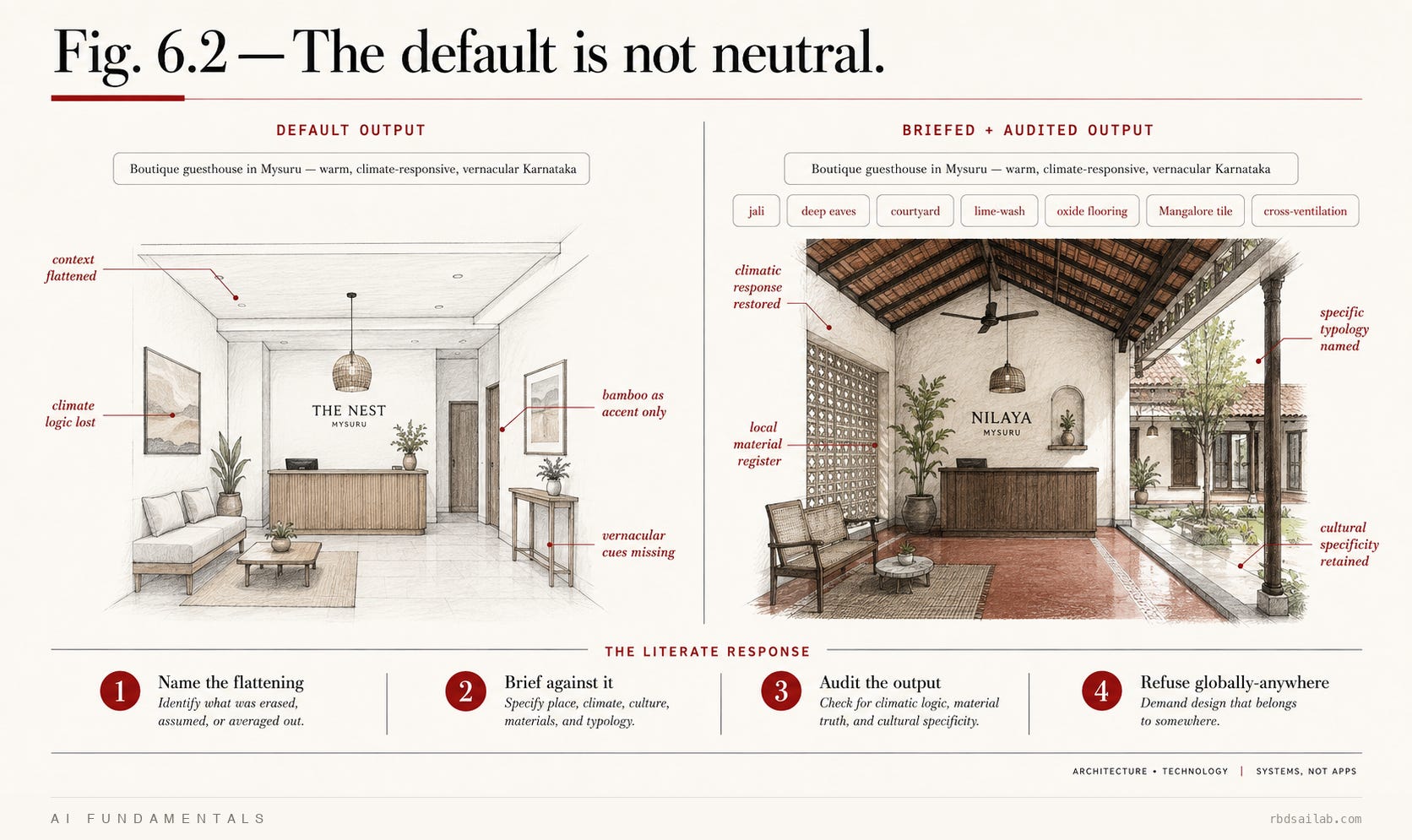
A small practice working on a boutique guesthouse in Mysuru. Eight rooms. Climate-responsive. Vernacular Karnataka. The designer briefs a multimodal system: “warm, contextually grounded reception space, 4×4m, bamboo and lime-wash, soft afternoon light.”
The output is beautiful. Pale wood. White walls. Raked light. Low ceilings. Recognisable in any global hotel chain and recognisable nowhere in Karnataka in particular. The bamboo is a stylised accent. The limewash becomes anonymous white surface. The climatic logic — high ceilings, deep eaves, verandah thickness, jali screens, cross-ventilation, the actual reason the typology exists — is absent. The image is not technically wrong. The cultural neutrality is.
For twenty years, the profession has used globally minimal as a soft cover for a much sharper act — the flattening of cultural specificity into a register recognisable everywhere because it is anchored nowhere. The phrase had plausible deniability when the flattening was one designer’s stylistic choice. AI removes the deniability. The model does this by default, in seconds, repeatedly, until the architect names it and refuses it. The flattening is now visible as a structural property of the tool, not merely a private aesthetic preference. That is the social function the profession has not yet named at the AI level.
The literate response is four moves, in order:
Name the flattening. Surface it explicitly — to the team and the client. Call the default what it is, and identify which culturally specific decisions the model has dissolved. The unnamed default is the dangerous one, because it enters the design review as taste.
Brief against it. Specific reference imagery — Charles Correa, Geoffrey Bawa where appropriate, vernacular Karnataka sources when the project is in Karnataka — named local typologies (verandah, jali, courtyard), vernacular materials (Mangalore tile, oxide flooring, laterite, lime-wash), and climatic responses. The brief becomes the counterweight to the corpus.
Audit the output. A re-prompted output can still carry the residual default. The audit is non-negotiable. Does the lime-wash read as lime-wash or as gypsum board; are the eaves doing climatic work or only styling the elevation; is the jali serving privacy and air movement or only ornament. does the section know the climate, or only the mood-board.
Refuse to ship anything that reads as globally-anywhere when the project is specifically-here. The load-bearing move. The naive architect ships the Scandinavian-flavoured image, calls it warm and modern, and reproduces the bias in built form. The literate architect refuses, re-briefs, and authors against the model.
What this returns to the architect
Each layer asks for a different stance. Compute and energy ask for briefing discipline — every iteration is a small energy decision; the frivolous prompt is no longer free. Labour asks for supply-chain literacy — the annotator is part of the supply chain of the prompt, the way the brick-layer is part of the supply chain of the wall. Training data asks for curatorial refusal — the default register is not neutral; the architect briefs against it. Bias-in-built-form asks for authorship at the audit — the published image carries forward whatever the architect did not refuse.
None of these are theoretical positions. They are operational — IP-clearance checklists, provenance audits, named-author conventions, energy-aware iteration policies, and the procurement-side conversation with the client about what AI was used for. The article opens the door at the literacy level. The protocol is the next move.
The conventional formulation is use AI responsibly. The deeper version is sharper. The model accelerates manifestation. The architect decides what is permitted to be manifested, in whose name, at whose cost, and audits the output for the residue of every layer the model did not show. Spectacle is easy. Responsibility is the discipline that survives spectacle.
For how the architect-as-systems-thinker translates this entire literacy into a working studio system of vector databases, agents, and orchestrators, read Part 7.
The four layers are teachable, but not by reading. They install against the studio’s actual deliverables — IP-clearance checklists, provenance audits, named-author conventions, the brief that holds against the corpus rather than collapsing into it. We run a one-day workshop — the AI Fundamentals for Architects and Designers — for exactly this: the room where ethics stops being an article and becomes the protocol the studio practises.
Reach out to us at rbdsailab.com to bring the workshop to your city.
Sources
[1] Cottier et al. The rising costs of training frontier AI models. arXiv 2405.21015, 2024. https://arxiv.org/abs/2405.21015 · Epoch AI, How much does it cost to train frontier AI models? https://epoch.ai/blog/how-much-does-it-cost-to-train-frontier-ai-models
[2] IEA. Energy and AI — Energy demand from AI. April 2025. https://www.iea.org/reports/energy-and-ai/energy-demand-from-ai · Crownhart, These four charts sum up the state of AI and energy. MIT Technology Review, April 17, 2025. https://www.technologyreview.com/2025/04/17/1115320/four-charts-ai-energy/
[3] The carbon and water footprints of data centers. Patterns (Cell Press), 2025. https://www.cell.com/patterns/fulltext/S2666-3899(25)00278-8
[4] Perrigo, Billy. Exclusive: The $2 Per Hour Workers Who Made ChatGPT Safer. Time, January 18, 2023. https://time.com/6247678/openai-chatgpt-kenya-workers/
[5] Hao, Karen. Empire of AI: Dreams and Nightmares in Sam Altman’s OpenAI. Penguin Random House, May 2025. https://www.penguinrandomhouse.com/books/743569/empire-of-ai-by-karen-hao/ Tech Policy Press, 2025. https://www.techpolicy.press/decolonizing-the-future-karen-hao-on-resisting-the-empire-of-ai/
[6] Crawford, Kate. Atlas of AI. https://katecrawford.net/atlas · LAION-5B documentation. https://laion.ai/blog/laion-5b/
[7] Nicoletti and Bass. Humans Are Biased. Generative AI Is Even Worse. Bloomberg, June 2023. https://www.bloomberg.com/graphics/2023-generative-ai-bias/
[8] Schneider and Hagendorff. Investigating toxicity and bias in Stable Diffusion text-to-image models. Scientific Reports, 2025. https://www.nature.com/articles/s41598-025-12032-4 · Algorithmic bias in image-generating AI. Information, Communication & Society, Nov 2025. https://www.tandfonline.com/doi/full/10.1080/1369118X.2025.2584146
[9] Qadri et al. AI’s Regimes of Representation. ACM FAccT / arXiv 2305.11844, 2023. https://arxiv.org/abs/2305.11844 · Sukkar. Artificial Intelligence Islamic Architecture (AIIA). Buildings, 2024. https://www.mdpi.com/2075-5309/14/3/781 · Pishahang and Badiei. From Clay to Code. arXiv 2601.00029, 2026. https://arxiv.org/abs/2601.00029
I’m Sahil Tanveer of the RBDS AI Lab, where we explore the evolving intersection of AI and Architecture through design practice, research, and public dialogue. If today’s post sparked your curiosity, here’s where you can dive deeper:
Read my book – Delirious Architecture: Midjourney for Architects, a 330-page exploration of AI’s role in design → Get it here
Join the conversation – Our WhatsApp Channel AI in Architecture shares mind-bending updates on AI’s impact on design → Follow here
Learn with us – Our online course AI Fundamentals for Lighting Designers is power-packed with 17+hrs of video content through 17 lessons → Enroll Here
Explore free resources – Setup guides, tools, and experiments on our Gumroad
Watch & listen – Our YouTube channel blends education with architectural art
Discover RBDS AI Lab – Visit our website
Speaking & events – I speak at conferences and universities across India and beyond. Past talks here
📩 Enquiries: sahil@rbdsailab.com | Instagram