

The Paperwork Gets There First
On honoraria, expertise, and the categories institutions write into their programmes.


Earlier this month I took a call from the training arm of a national professional body. They were putting together a session on artificial intelligence and wanted me to moderate it.
I said that I am not a moderator. I am a speaker.
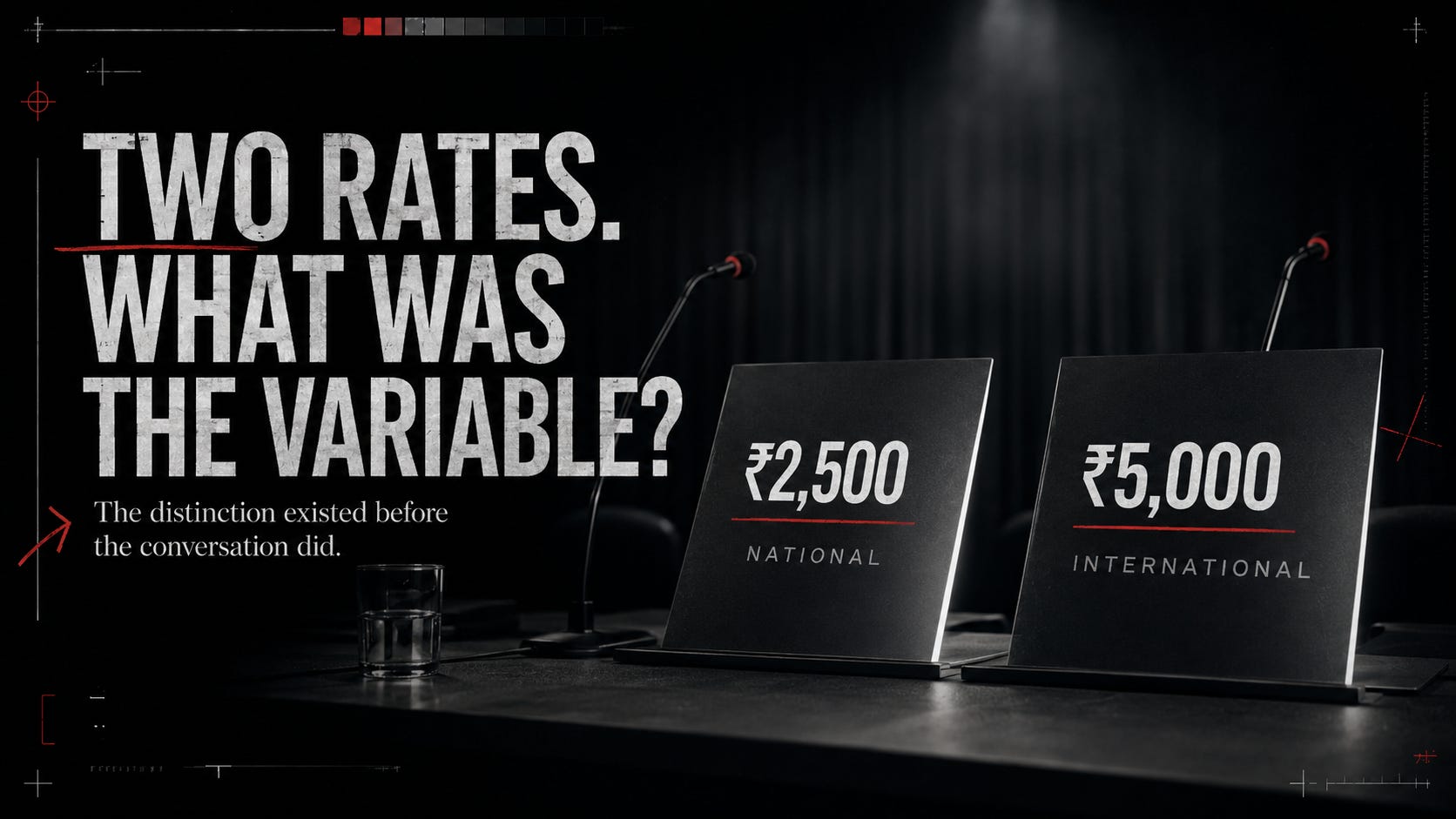
The caller accepted the point quickly and moved to the honorarium. ₹2,500 for me. ₹5,000 for the international speaker. That, he said, was the policy.
I asked why the two figures were different. He offered to check with the committee whether they could pay me ₹5,000 as well. I asked him to put the proposal in writing and ended the call.
I should clarify something before this becomes an essay about whether ₹2,500 is a large or small amount. It is not.
Commercial speaking and educational work are different categories for me. For professional engagements I charge a professional fee. For educational work I usually work for a much smaller honorarium because the reason for being in the room is different. Sometimes I have spoken for less. Sometimes I have spoken for nothing. There are institutions, students and conversations worth showing up for without turning every hour into a market transaction.
The problem was not that ₹2,500 failed to match even remotely what I might charge elsewhere.
The problem was that there were already two numbers on the table, and the explanation for the difference was not preparation, experience, subject knowledge, travel, role or anything else about the work.
It was “international speaker.”
The written proposal arrived shortly afterwards.
It is that document, more than the phone call, that this essay is actually about.
A schedule is a plan
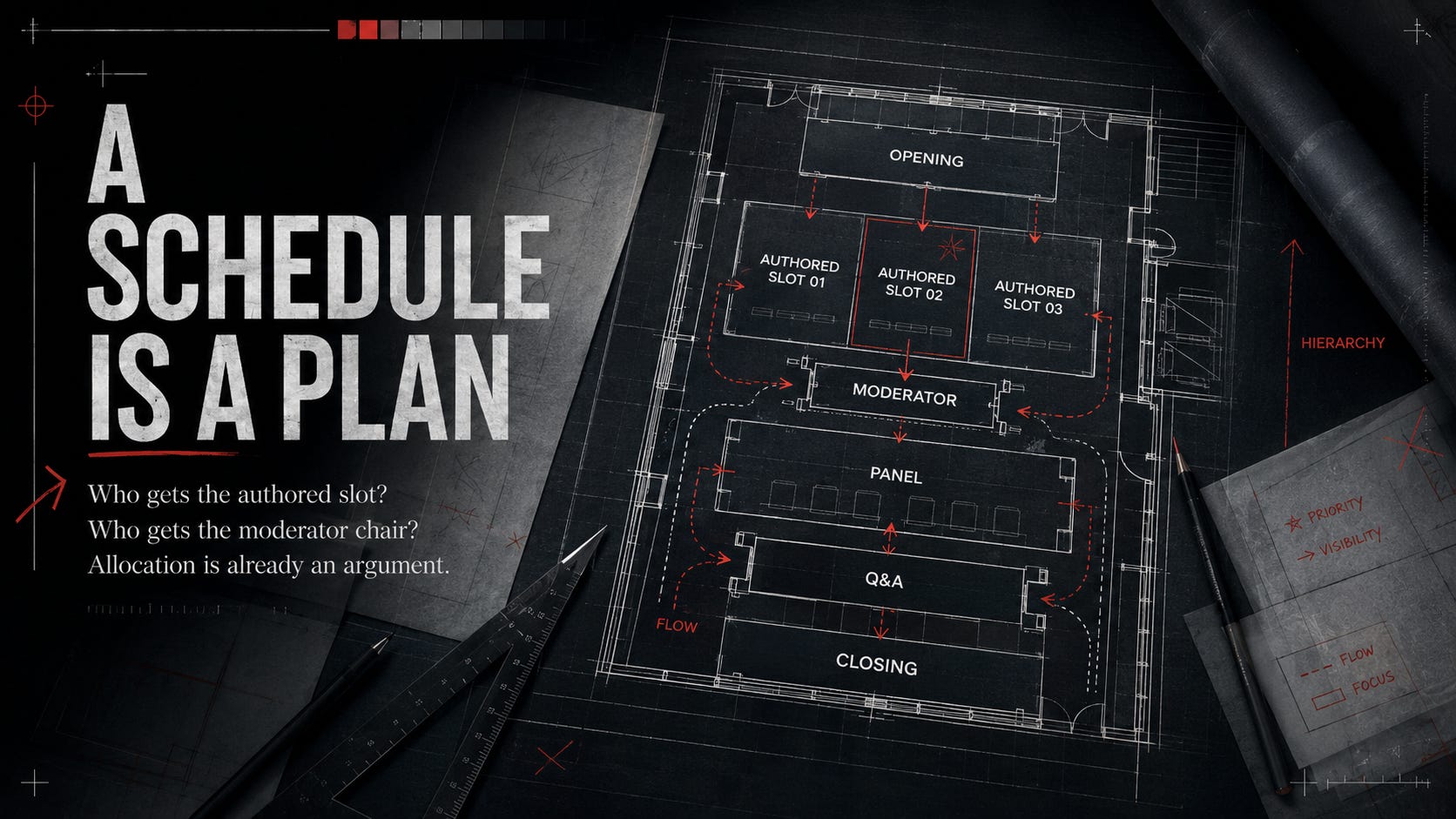
Architects read drawings for a living, and one of the first things a plan teaches you is that a drawing does not need to explain its priorities. It has already made them.
You can see which rooms receive the light and which were fitted into what remained. You can see which spaces were given frontage, which sit at the centre of circulation and which exist mainly to connect more important rooms. A concept note can describe a building as democratic, open or contextual. The plan will usually tell you whether that is true.
A programme schedule works in much the same way.
It allocates a scarce resource — time in front of an audience — among people. It decides who authors a subject, who responds to it, who asks the questions and who is expected to hold the conversation together. Those decisions look administrative, but they are also intellectual decisions.
The document I received had two other panellists, one international and one national, each with a thirty-minute authored slot and a title of their own. My only appearance in the programme was moderating the debate between them.
My designation was National Speaker 2.
My biography described me vaguely as an emerging technology practitioner contributing to the discussion. While being a published author and running a lab working precisely at the intersection the event wanted to discuss. The email and the attached programme spelled my name in two different ways, and neither was correct. My city was wrong. Near the end was a line thanking me for my kind acceptance, which I had not given. I had asked for the proposal in writing precisely because I had not accepted anything on the phone.
Any one of those things could be an administrative mistake. Names are mistyped. Old biographies are copied. Templates travel from one email to another. A spelling error does not reveal an institutional ideology.
But the wrong name, wrong city, borrowed acceptance, vague biography, moderator slot, National Speaker label and two different honoraria all arrived in the same document.
Individually, each one is small. Together, they describe an arrangement.
The panel I was being asked to moderate was titled The Indian Architect in the Age of AI (which has since been renamed and released under a different title).
I want to be careful here because this is where an essay like this can turn into a complaint, and a complaint is smaller than what happened.
The programme had answered part of its own question before the panel had even met.
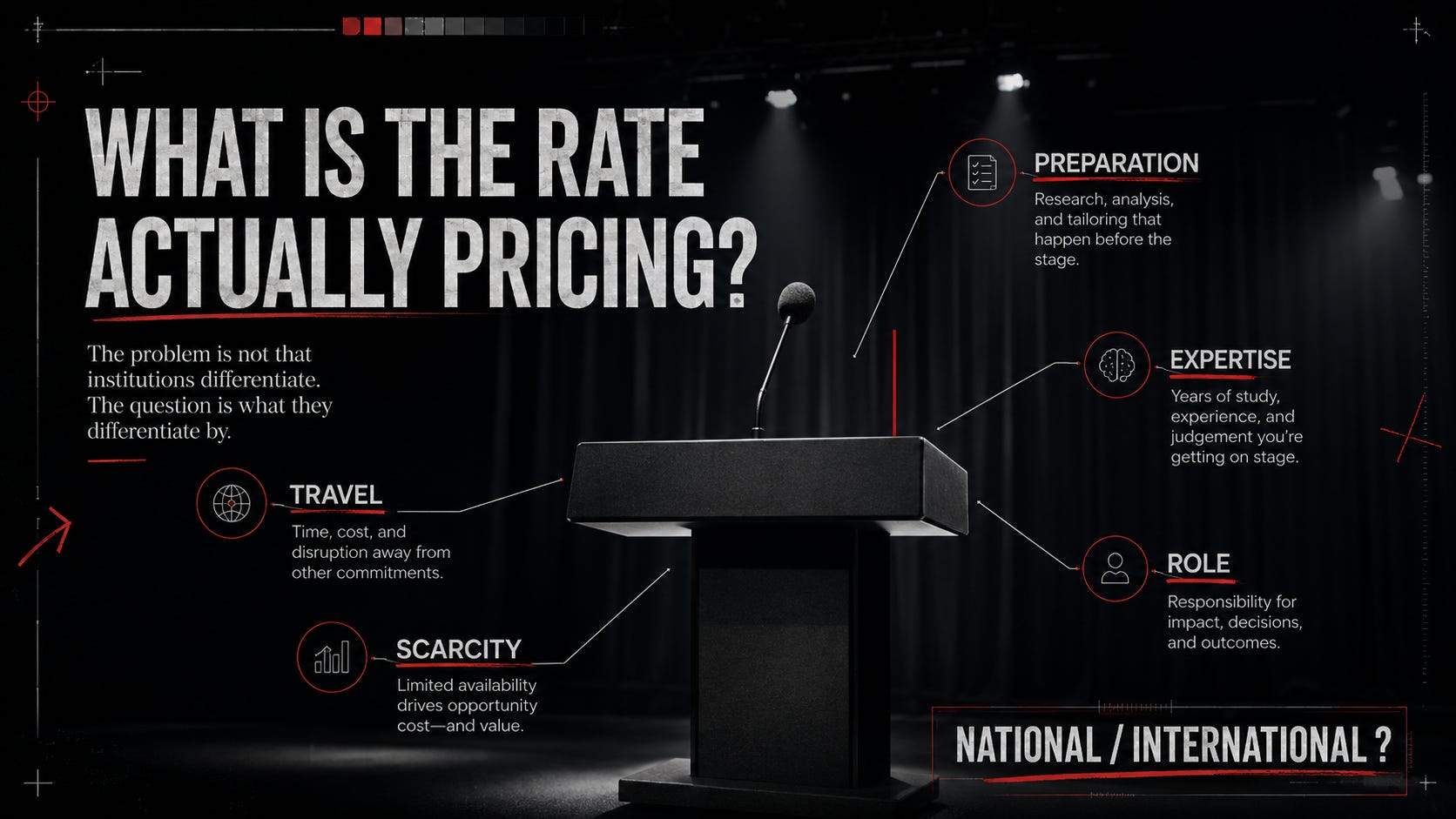
What exactly is an honorarium pricing?
The easiest argument would be that professional bodies should simply pay speakers more. I do think many should. But the public record makes the issue more interesting than that because there is no single correct price for an hour of speaking.
An hour is not always the same hour.
One person may arrive with a lecture they have delivered twenty times. Another may be asked to develop something new. A panel appearance is different from chairing the panel. A workshop may require several hours of preparation before anyone enters the room. A recorded lecture that remains online is different from a conversation that disappears when the room empties. Travel matters. Preparation matters. Intellectual property matters. Experience, scarcity and the institution’s own ability to pay can matter.
An honorarium cannot sensibly price minutes alone. It is an institutional judgment about the contribution being requested.
Indian institutions already make those judgments in several different ways.
The University Grants Commission’s current Malaviya Mission Teacher Training Programme guidelines pay local and outstation resource persons ₹5,000 for a ninety-minute session, capped at ₹10,000 a day. The same programme expects the resource person to deliver the session and submit a session plan and five MCQs in advance.
The National Institute of Technology Calicut’s continuing-education guidelines use a different logic. Experts from reputed industry or academia, in a faculty cadre or equivalent, are paid according to level: ₹3,500 an hour for a Professor, ₹2,500 for an Associate Professor and ₹1,500 for an Assistant Professor, with daily caps and provision for exceptions in special circumstances.
Then there is the UGC’s Professor of Practice framework, created specifically to bring professional expertise into higher education. It recognises proven professional expertise and experience even where conventional academic qualifications are absent. When an institution funds the position itself, remuneration can be a consolidated amount “mutually agreed between the institution and expert.” For an honorary Professor of Practice, the institution decides the honorarium from its own resources.
These are three different systems using three different kinds of judgment.
That is the point.
The problem is not that institutions differentiate.
They should.
The question is what they choose to differentiate by.
The same system, another variable
The Government of India’s Global Initiative for Academic Networks, or GIAN, makes that question unusually visible.
GIAN exists specifically to bring international academic talent into Indian higher education. Its purpose matters. This is not an ordinary lecture programme accidentally paying someone from abroad differently. Internationalisation is the programme.
Under its current Phase V guidelines, foreign faculty must hold a passport from a country other than India or have a permanent foreign affiliation, and they must teach at least sixty per cent of the course. Course proposals are reviewed by subject experts.
The same document publishes the honoraria. Indian host faculty and other Indian instructors may receive ₹5,000 per lecture hour. In virtual courses, foreign faculty honoraria are capped at US$250 per hour. For courses approved in FY 2025–26, the scheme fixed its own conversion rate at ₹86 to the dollar, making the foreign-faculty ceiling ₹21,500 per hour.
A little over four times the Indian figure.
But ceiling matters. The document does not say every foreign faculty member receives that amount. And the purpose of the programme matters too. A scheme created to attract overseas expertise may reasonably need to compete with different markets, absorb different costs and make participation worthwhile. The foreign faculty also carries most of the teaching load.
So I do not think GIAN proves that Indian institutions simply value foreigners four times more. That would be an easy line and a bad argument.
It proves something more useful: institutions are entirely capable of pricing intellectual work differently when they believe there is a reason to do so. They can define the category, write the distinction into policy and explain the purpose behind it.
The question is whether international should become a shortcut for value outside a programme whose explicit purpose is internationalisation.
If travel is the reason, pay travel. If new material is being commissioned, price the commission. If expertise is scarce, recognise the scarcity. If the teaching load is larger, price the load. If an institution is competing with another professional market, say so.
Those are intelligible variables.
A passport, by itself, is not a measure of expertise.
Neither is an Indian passport.
I don’t know what was in anyone’s head
There is a temptation to give this behaviour a larger name: colonial hangover, foreign validation, prestige bias, inferiority complex.
I am not going to do that.
I looked for research that would allow me to make that leap responsibly. A preregistered study published in eLife asked 4,147 scientists across six disciplines to evaluate abstracts carrying different country and institutional status signals. The researchers found only weak and inconsistent evidence of country- or institution-related status bias.
That study is about scientific peer review, not Indian professional events. It cannot tell me what anyone on that phone call believed.
I do not need it to.
I have the programme.
The caller was courteous throughout. I have no reason to think he intended to insult me. He was conveying a structure that already existed. That is more interesting than open condescension because institutional hierarchy rarely announces itself in complete sentences. It survives much more efficiently inside ordinary categories.
National speaker.
International speaker.
Moderator.
Keynote.
Guest.
Expert.
Once the category exists, the judgment begins to look like administration.
An earlier call
This was not the first time.
A few months ago, another centre of the same professional body asked me to moderate a panel whose speakers were all international. No honorarium was mentioned for me.
I declined.
What came back is the part I remember. I should be precise because this was a phone call and I do not have a written record. As I recall it, I was told that I would get the opportunity to interact with international speakers. I could ask them what I wanted to know. I must have doubts, and this would give me access to people who could answer them.
It was said warmly, as though something were being offered.
Inside that offer was a complete arrangement of knowledge. The international speakers possessed it. The Indian professional had questions. Moderation was the mechanism through which he could sit close enough to ask them.
I cannot know whether that reflected institutional policy, one person’s assumptions or simply a clumsy attempt to persuade me to participate.
But I know what the sentence placed where.
Months later, a different centre of the same body sent me a programme titled The Indian Architect in the Age of AI in which the roles had already been allocated.
Moderation is not lesser work
Researching this essay corrected one part of my own reaction.
I had read the moderator slot as the lesser slot because, in this instance, I had been approached for a subject I work on and then placed between two authored presentations. But moderation itself is not lesser work.
A good moderator may do more preparation than a panellist. They have to understand several positions, manage time, find the useful disagreement and keep the conversation from becoming three parallel monologues.
The Australian National Association for the Visual Arts Code of Practice makes this explicit. Its published rates recommend A$257 for a panellist appearing for an hour or less and A$505 for the chair or facilitator. A one-hour keynote is priced separately at A$1,680 and above. If an appearance is made publicly available indefinitely as a recording, NAVA recommends an additional twenty per cent. Its workshop guidance also says preparation and materials-sourcing time should be accounted for.
I am not interested in converting those Australian figures into rupees. The numbers belong to another economy.
The structure is what matters.
It asks what work the person is being asked to do.
That distinction improves my own argument. My objection is not that I am too important to moderate. Moderation and authorship are different forms of work, and I had already told the organiser which one I was available to do. A policy could have paid the moderator more than the speakers and I would still have declined the role.
Money and role are connected here, but they are not the same question.
Another useful model comes from Working Artists and the Greater Economy, or W.A.G.E., which runs a voluntary certification system for nonprofit arts institutions in the United States. It distinguishes an existing talk from a newly commissioned one. It treats travel and accommodation separately from the artist fee. Most importantly, its fee structure scales according to the institution’s annual operating expenses.
A small organisation and a large institution are not asked to pretend they have the same capacity to pay.
W.A.G.E. reports that more than US$25 million has been paid to artists through participating institutions since its certification programme launched in 2014.
Again, the American amount is not the lesson.
The variables are.
A useful honorarium policy could ask whether the presentation already exists or must be created, whether the person is speaking or chairing, how much preparation is required, whether the material will be recorded and redistributed, whether travel is involved, whether the expertise is unusually specialised, and what scale of institution is commissioning the work.
Those questions will not always produce equal rates.
They should not.
The problem is not that two experts might be paid differently. The problem begins when the institution cannot explain the variable separating them except with a label that has very little to do with the work.
The international expert is not the problem
None of this is an argument against the international speaker.
I do not know him well enough to price his expertise, and I have no interest in doing so. He may be worth ₹5,000. He may be worth much more. He may have accepted a fraction of what he normally charges because he wanted to contribute to an Indian professional conversation.
My argument does not require him to be worth less.
It requires the institution to know why it thinks one contribution should be valued differently from another.
There are excellent reasons to bring knowledge across borders. Architecture would be poorer without them. The opposite mistake would be equally foolish: Indian knowledge is not automatically better because it is Indian. Local practice can be shallow, dated and poorly examined. International expertise can expose blind spots a profession has normalised for years.
The useful distinction is not foreign versus local.
It is relevant versus irrelevant, deep versus shallow, prepared versus generic, tested versus borrowed, and appropriate versus inappropriate to the problem in front of us.
That is the discrimination I want institutions to become better at.
There was a temptation in my first draft of this essay to spend several paragraphs proving why my own work in artificial intelligence deserves a different valuation.
I took them out.
The institution had already called me.
That is enough.
An invitation is itself a professional judgment. Someone has decided that the person being invited knows something worth putting in front of an audience. The next conversation should therefore be about the nature of the contribution, the terms of the engagement and what both sides expect from it.
Nor should an institution be expected to meet every speaker’s commercial rate. Honoraria exist partly because professional contribution often sits somewhere between commerce and service.
But symbolic payment is still a form of speech.
₹2,500 may say, this is what we can afford.
₹2,500 for everyone may say, this is the standard token our institution uses.
₹2,500 for one category and ₹5,000 for another says something else because now the institution has demonstrated that it is willing to distinguish.
The question becomes what the distinction means.
The paperwork gets there first
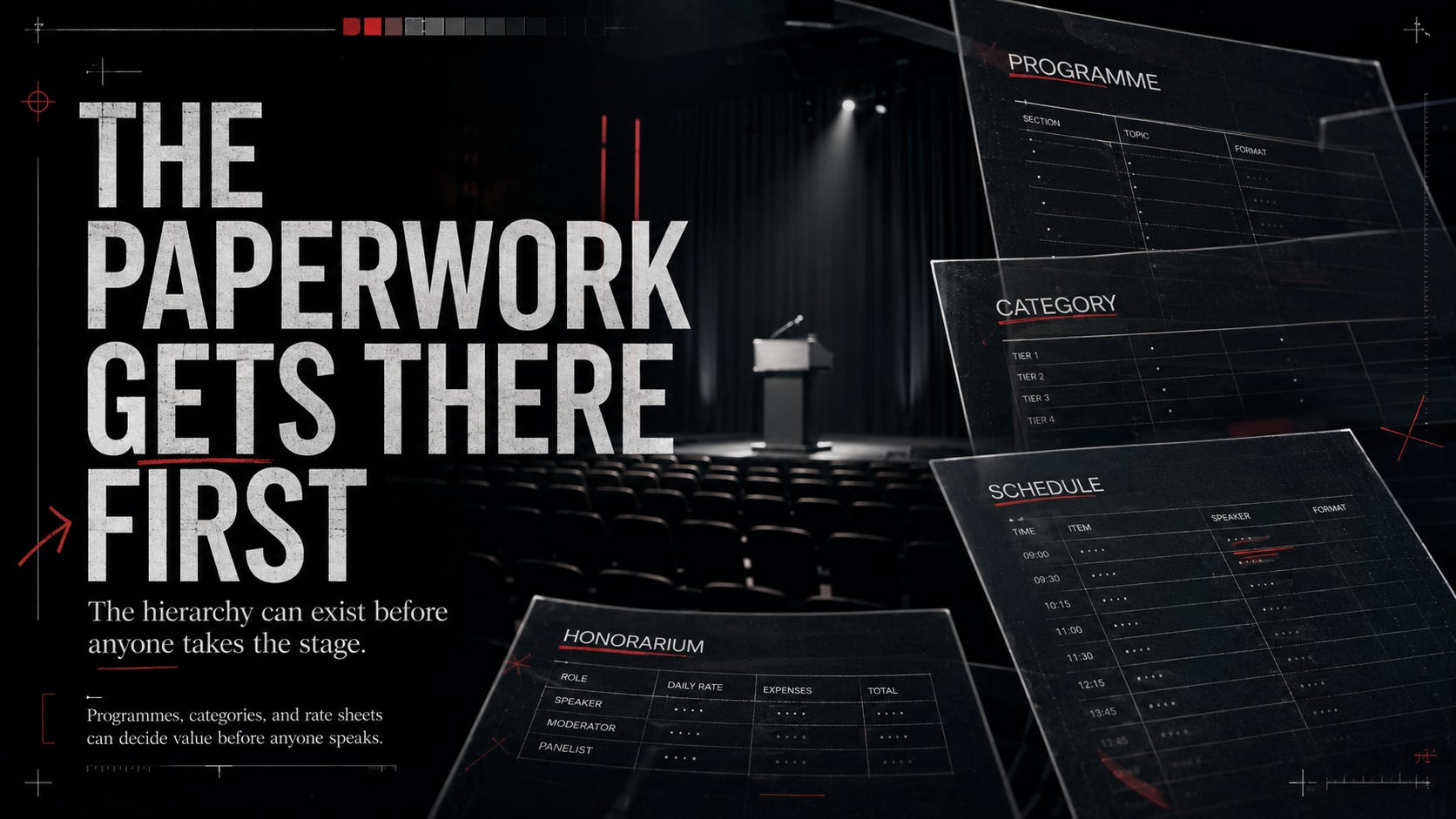
Institutions rarely announce their valuations.
Most of the people administering events are not constructing theories of professional hierarchy. They are filling cells in spreadsheets, copying biographies into templates, assigning labels, checking old policy documents and moving names into empty programme slots.
That is precisely why the paperwork matters.
A plan becomes architecture through many small decisions. No single wall explains the building. No single door establishes its hierarchy. But when enough decisions point in the same direction, the organisation of the whole becomes legible.
Programmes work the same way.
The valuation enters through the designation, the slot length, the order of speakers, the biography someone did or did not read, the role somebody assumed you would accept, and the rate table that appears to require no explanation because it existed before your name arrived.
By the time anyone says anything out loud, the decision is already drawn.
I no longer treat that paperwork as administration to be corrected after agreeing in principle.
I read it first.
For educational work I have a standard honorarium. There are occasions when I will reduce it or waive it because the institution, the audience or the conversation matters to me. That decision is mine to make. I also do not normally moderate. Not because moderation is below speaking, but because it is not the professional function for which I want to be engaged.
An institution is free to say that it cannot meet my terms.
I am free to decide that I want to come anyway.
That is a professional conversation between two parties. It requires no outrage.
What I am no longer willing to do is accept a valuation that appears to have been settled by a category before anyone has asked what work is actually being commissioned.
The committee now has my terms in writing.
It can accept them or decline them.
Either answer is fine.
What matters is that this time, the decision will have to be made after the question has been asked.
Sources and research notes
The personal incident described in this essay is based on the author’s phone conversations, email correspondence and programme document. The institution has intentionally not been named. Published references below were checked against their source pages on 11 August 2026.
University Grants Commission — Malaviya Mission Teacher Training Programme (MMTTP). Resource persons are paid ₹5,000 per ninety-minute session, with a maximum honorarium of ₹10,000 per day. The programme also describes advance preparation expected from resource persons.
UGC MMTTP — Financial Norms
UGC MMTTP — Resource Person responsibilitiesNational Institute of Technology Calicut — Centre for Continuing Education and Skill Development. Published honoraria for experts from reputed industry/academia or equivalent are ₹3,500/hour for Professor, ₹2,500/hour for Associate Professor and ₹1,500/hour for Assistant Professor, with daily caps and scope for exemptions in special circumstances.
NIT Calicut — Guidelines for Conducting ProgrammesUniversity Grants Commission — Guidelines for Engaging Professor of Practice in Universities and Colleges. The framework recognises proven professional expertise and experience. For HEI-funded engagement, remuneration can be a consolidated amount mutually agreed between the institution and expert; HEIs may determine honoraria for honorary Professors of Practice from their own resources.
UGC — Professor of Practice Guidelines (PDF)Global Initiative for Academic Networks (GIAN) — Phase V Guidelines. Foreign faculty must hold a non-Indian passport or permanent foreign affiliation; at least 60% of the course must be taught by foreign faculty. Indian instructors may receive ₹5,000 per lecture hour. Foreign faculty teaching virtually are capped at US$250/hour. For courses approved in FY 2025–26, the programme fixed a conversion rate of ₹86/US$. Proposals are reviewed by subject experts.
GIAN Phase V Guidelines (PDF)
JNU — GIAN programme pageNielsen, M. W., Baker, C. F., Brady, E., Petersen, M. B. & Andersen, J. P. (2021). “Weak evidence of country- and institution-related status bias in the peer review of abstracts.” eLife, 10:e64561. Preregistered survey experiment involving 4,147 scientists across six disciplines.
eLife article
DOI: 10.7554/eLife.64561National Association for the Visual Arts (Australia) — Code of Practice. Published fees distinguish panel appearance, panel chair/facilitator and keynote presentations; NAVA also recommends an additional 20% for indefinitely available recordings and separately notes that workshop preparation time should be accounted for.
NAVA — Speaking and Presenting Fees
NAVA — Workshop FeesWorking Artists and the Greater Economy (W.A.G.E.) — Certification. The system distinguishes existing talks from commissioned talks, separates artist fees from basic programme costs such as travel and accommodation, and scales fees according to institutional operating expenses. W.A.G.E. reports more than US$25 million paid to artists through participating institutions since certification launched in 2014.
W.A.G.E. Certification and Fee Structure
W.A.G.E. — About
I’m Sahil Tanveer. I run RBDS AI Lab, where we study what AI is actually doing to architectural practice — through built work, research, and teaching.
The book, the courses, the channels, the free tools, past talks — everything is in one place: rbdsailab.com.
Enquiries: sahil@rbdsailab.com
A small postscript to the essay.
The institution I wrote about has now announced the programme. I am, unsurprisingly, not part of it. That is perfectly fine. An institution is free to decline my terms, just as I am free to decline an engagement.
What is less easy to understand is that nobody thought it necessary to reply.
I was asked to put my position in writing. I did. The proposal was apparently considered, the programme was revised, and the event went ahead, but there was no acknowledgement, no decline, not even a two-line note closing the conversation.
This is a one of the premier professional bodies that regularly speaks to architects about standards, conduct and professional responsibility.
Perhaps professional courtesy is a very small thing compared to policy, regulation and institutional programmes. But professions are built out of small things too.
You do not have to agree with someone's terms.
You do have to answer them.
If I moderate I'm $500 per hour of face to face plus the same time in preparatory interviews and planning. That is 5 hours moderation plus 5 hours prep: $5000 (plus VAT, etc.)
If I facilitate its $5000 per day plus $500 per hour for the three to five days preparation: interviews, reading, analysis of issues, meetings with the convening team, etc.
If I speak its all expenses (business class air travel and 5 star accommodation) with a $10,000 honorarium. If I pass through more than 3 time zones, I must arrive 24 hours before appearance. No change to fee.
Organizers need to understand, the deal is about value, not time.