

The Software Is Listening
Field notes, No. 1 — four changes architects should notice as of July 2026, what each can do, what it cannot, and one thing to try at your desk.

For the past three months, this page has been a classroom. Seven essays walked through the machinery inside our new tools, from probability and tokens to diffusion and the studio stack. I wrote them slowly and on purpose, because machinery deserves patience. While I was writing about the machines, the field kept moving, and some of that movement now matters at the desk.
So this piece is a different kind of note. It collects four changes worth noticing now, even though they arrived at different times over the past year. For each one, I will say what has actually changed, what the system can and cannot do, and what it means for the way we work. Each section ends with one small action you can take this week.
The title is a figure of speech, so let me say plainly what it means. Software is not conscious, and it does not understand buildings. What is new is that everyday design tools can now accept instructions in ordinary language, answer questions about our own models, and read parts of our drawings. That is all that “listening” means here. It is also enough to change some daily work.
1 · You can now talk to SketchUp, Fusion, and Revit
Between late April and June this year, three official connectors arrived for tools most of us already use. Trimble released a SketchUp connector for Claude, an AI assistant. Autodesk connected Fusion to Claude through MCP, which is a standard bridge that lets an AI assistant use another program. And in June, Autodesk released the Revit Public MCP Server, a Technology Preview add-on for Revit 2027.
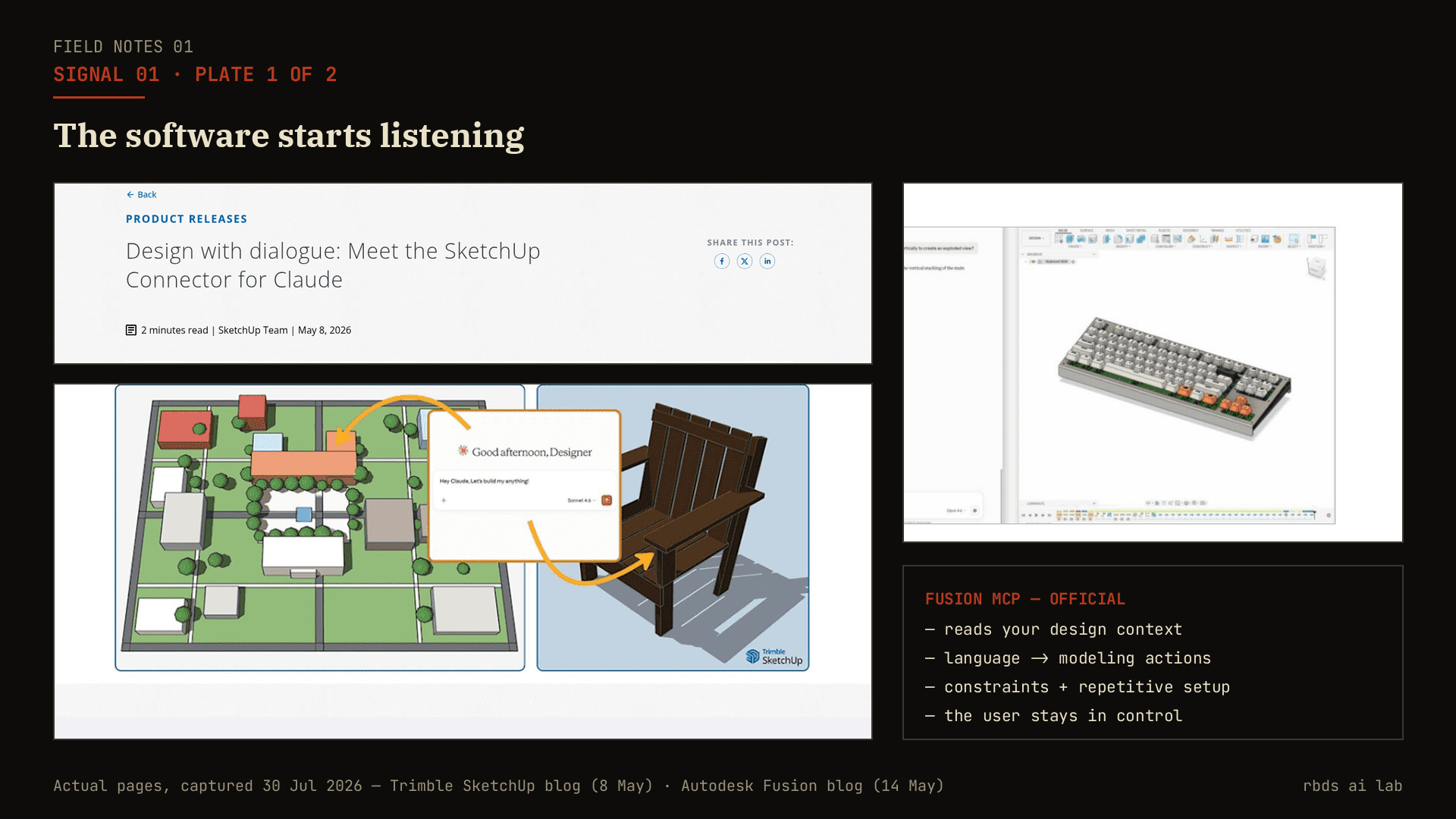
The SketchUp connector and the Fusion connection, as announced on the official pages. Credit: Trimble SketchUp blog; Autodesk Fusion blog.
The three connectors have different powers, and the differences matter. The SketchUp connector creates new models only. You describe what you want, attach a sketch or a floor plan if you have one, and it builds a fresh .skp file in the cloud. It can refine a model it generated earlier in the same session, but it cannot open or edit an existing .skp file. The free allowance of thirty models runs on SketchUp Free, which is not licensed for commercial use, so the free allowance must not be used for paid client work. The Fusion connection can read your design context and carry out supported modeling actions, which makes it useful for structured and repetitive steps rather than for complex production modelling. The Revit server is the most careful of the three. It can search a model, pull element data, select and zoom to elements, open views, and export images and schedules, but it does not change the stored model at all. Autodesk plans editing tools as a separate release, so that a firm can decide what an assistant is allowed to touch.
SketchUp’s team tests the Claude connector on real modeling prompts. Credit: Trimble SketchUp, YouTube.
Claude carrying out supported modeling steps inside Autodesk Fusion. Credit: Claude, YouTube.
The read-only choice in Revit points at the real shift. For twenty years, a BIM model was a thing you drew into. It is now becoming a thing you can also question, much as you would question a database. The architects who gain first will not be the ones generating shapes from prompts. They will be the ones who know what to ask a building they have already drawn, and who check the answers the way they would check a junior’s schedule.
At your desk this week: try the SketchUp connector on a small personal test, such as a massing study for an imagined plot. Because SketchUp Free is not licensed for commercial use, keep paid client work on your office’s paid subscription. Treat whatever comes back as a starting model that needs checking, never as a finished design.
2 · The AI in your renderer is included, not free
Chaos has now built Veras, its AI visualisation tool, into V-Ray, Enscape, and Corona. If your studio subscribes to an eligible Chaos plan, Veras arrives as part of the package rather than as a separate purchase. Included is not the same as free. Veras runs on Chaos Credits, a monthly allowance that comes with each plan and can run out. As of July 2026, Solo plans include one hundred credits a month, and larger plans include more, with extra credits available to buy.
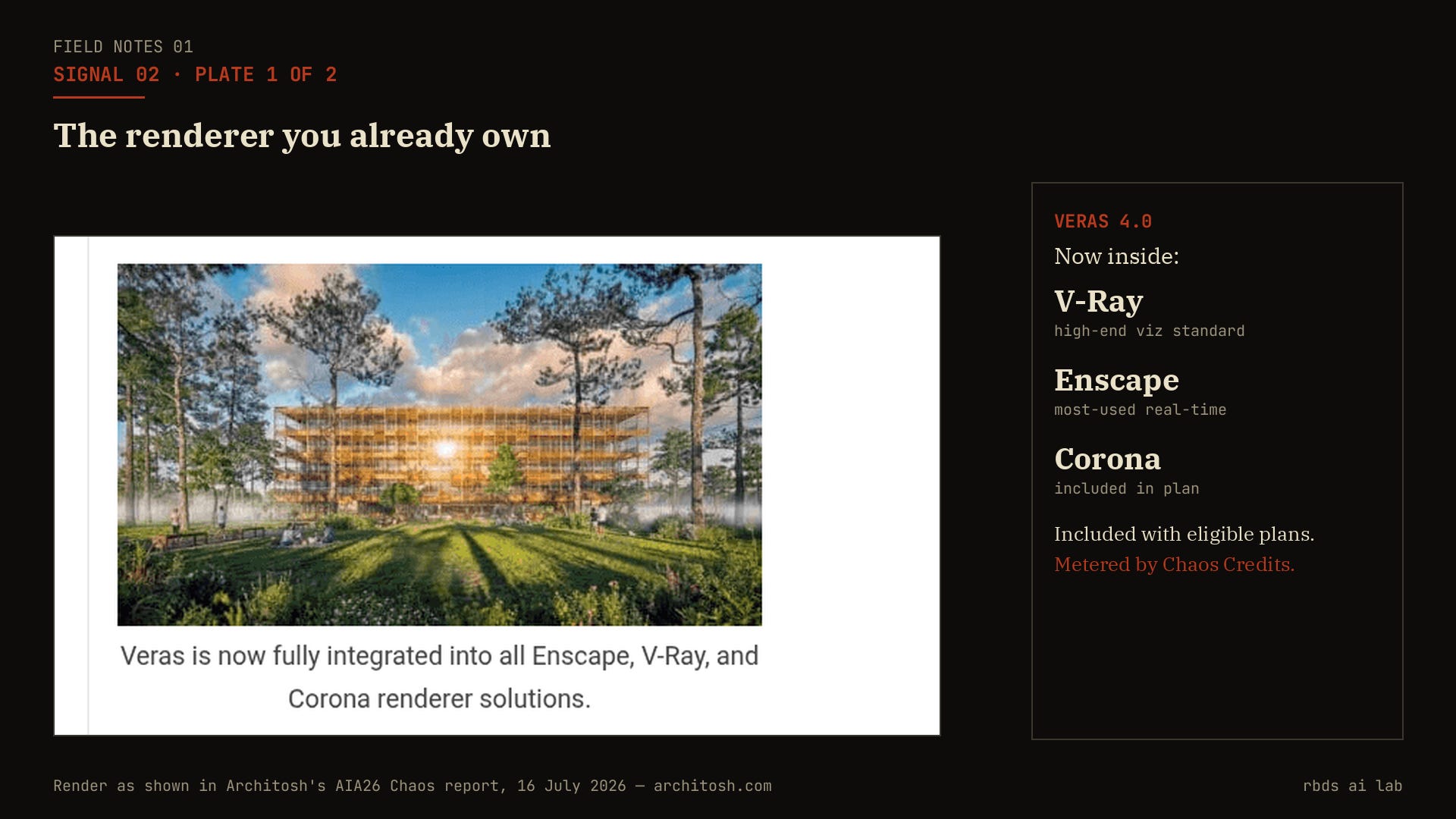
The integration as reported, with the plan and credit facts beside it. Credit: Architosh, AIA26 Chaos show floor report, July 16, 2026.
What it does is specific. It works up renders from 2D drawings and sketches, produces material variations from a single reference image, swaps seasons on a scene, makes short animations from stills, and offers new viewpoints. Those viewpoints are AI-generated visual interpretations, not geometrically faithful camera views taken from your coordinated model. All of its outputs are visual explorations rather than construction information, and each one still needs an architect’s checking before anyone else sees it.
A ten-minute hands-on tour of Veras 4.0. Credit: David Tomic, YouTube.
The practical question has therefore moved. It used to be whether the office should adopt an AI renderer at all. Now that the layer sits inside software many offices already pay for, the question is how to govern it. Someone has to decide who may spend the credits, on which projects, at which stage of work, and how a generated view gets checked against the model and the material schedule before a client sees it.
At your desk this week: run four material directions on one view of a test model or a non-confidential project, and note how many credits the run uses. Then judge the four options against your climate, your budget, and your maintenance plan, not against each other’s looks.
3 · Machines that read building plans — India has lived here for years
In the United States, several cities and counties have tested or deployed AI-assisted review support for permit applications. Gainesville, Pasco County, and Altamonte Springs in Florida are among them. In April 2025, California gave Los Angeles City and County a pre-check tool built by Archistar, free of charge, to speed rebuilding after the fires; it checks a design against zoning and building rules so owners can fix problems before they submit. Seattle began testing an AI prescreening tool called CivCheck with its building department in March 2025 and published the results this year. In all of these, the software checks, flags, and recommends. The officials still decide.
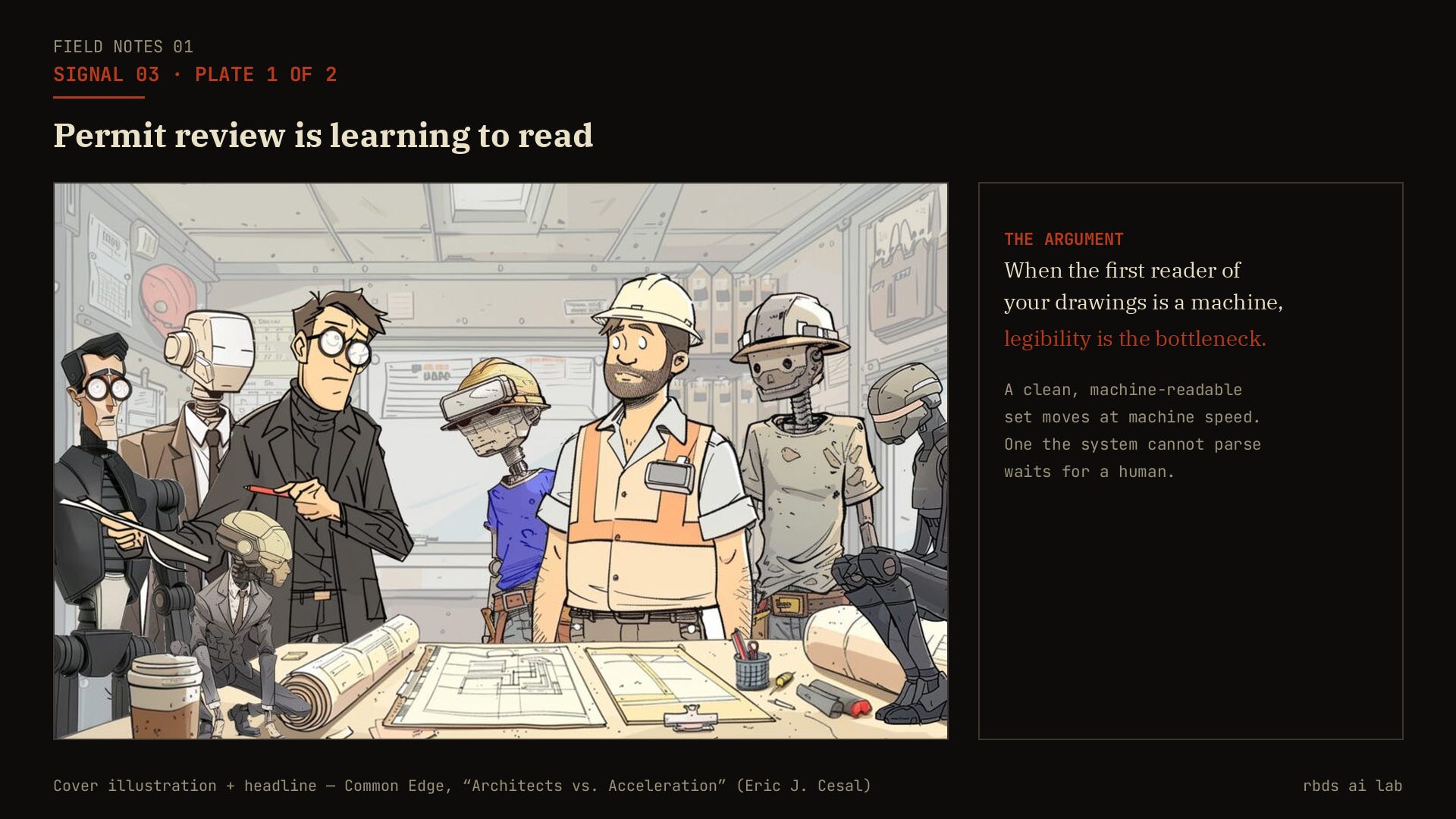
The cover illustration and core argument of the Common Edge essay on machine-readable drawings. Credit: Common Edge, “Architects vs. Acceleration,” Eric J. Cesal.
India has dealt with machine readers for years, in a more structured form. Mumbai and Pune require plans to pass AutoDCR, automatic plan checking software that reads a CAD file drawn on prescribed layers and checks it against the development rules. It works out FSI — the floor space index, which caps how much built area a plot may carry — along with setbacks, coverage, height, and parking. Bengaluru and Chennai run rules-based checking inside their own approval portals. Telangana began moving new applications to a platform called BuildNow in late 2024, kept TG-bPASS available for older pending cases, and closed TG-bPASS on December 15, 2025. The state describes BuildNow as AI-powered, and that is the state’s own description rather than an independently verified classification. In May 2026, the DDA launched a single-window clearance system under its online building permit system in Delhi. These systems are not all the same kind of machine, and the difference matters. Indian scrutiny is mostly rules-based, reading fixed layers against coded rules. The newer American pre-check tools try to interpret drawings with less dependence on a rigid file structure. That looser kind of reading is an emerging direction, not yet a settled fact.
A live walkthrough of Archistar’s automated design checks. Credit: AIA Los Angeles, YouTube.
For an Indian architect, the lesson is close to home. Anyone who has lost a week to an AutoDCR rejection over a layer name already knows what it feels like when a machine reads your drawing first. As the readers get smarter, the discipline that pays is the one that has always paid at the portal: clean, consistent, machine-readable drawing sets, with the data where the data belongs.
At your desk this week: pull out your office’s last AutoDCR or portal rejection note and read it again slowly. The list of what the engine could not read is a free report card on how machine-ready your drawings are.
4 · AI and copyright: three decisions, three different questions
In Kenya, the Copyright Tribunal decided a dispute over AI-assisted children’s books on August 22, 2025, and the ruling drew fresh attention this July. In its decision, the tribunal observed that material generated by a machine alone, without human effort and originality, sits outside copyright protection. That observation was not the central basis of the outcome. The dispute itself ended because neither side produced enough evidence for the authorship and ownership question to be resolved in that proceeding. Read that way, the case is a warning about proof as much as a statement about machines.
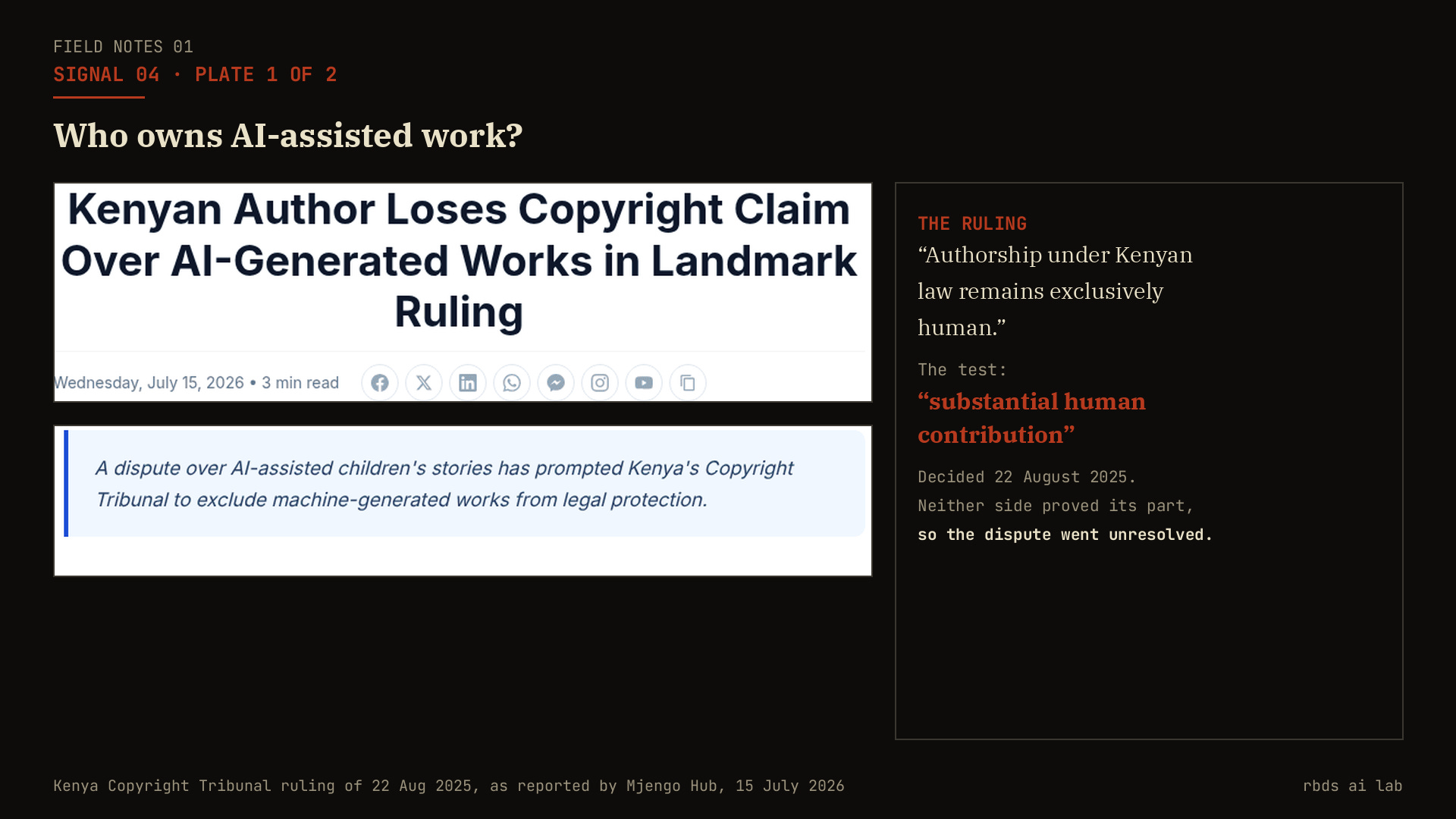
The Kenyan tribunal’s decision of August 22, 2025, as reported in July 2026. Credit: Mjengo Hub, July 15, 2026; ruling at Kenya Law, KECOT/2025/6.
Two other decisions frame the year, and each concerns a different question. In March 2026, the United States Supreme Court declined to hear Stephen Thaler’s appeal, which leaves in place the lower court’s position that a work created by a machine alone, with no human author, cannot be copyrighted. Declining to hear a case is not a new judgment on the merits. And on July 24, 2026, the Delhi High Court refused ANI’s request for an interim order against OpenAI. An interim order is a temporary restraint a court can grant while a case continues. On the evidence before it, the court’s preliminary view was that OpenAI’s use and storage of ANI’s material could count as fair dealing, the rule in Indian law that permits limited use of copyrighted work. The finding concerned only the interim request, and the final suit remains open.
It helps to keep the legal questions apart, because they are genuinely different. Whether a company may train on existing work is one question. Whether an AI-assisted output can be protected is another. Who owns that output, between you, your client, and your collaborators, is a third. The rulings above touch different questions in different countries, and none of them settles the whole field.
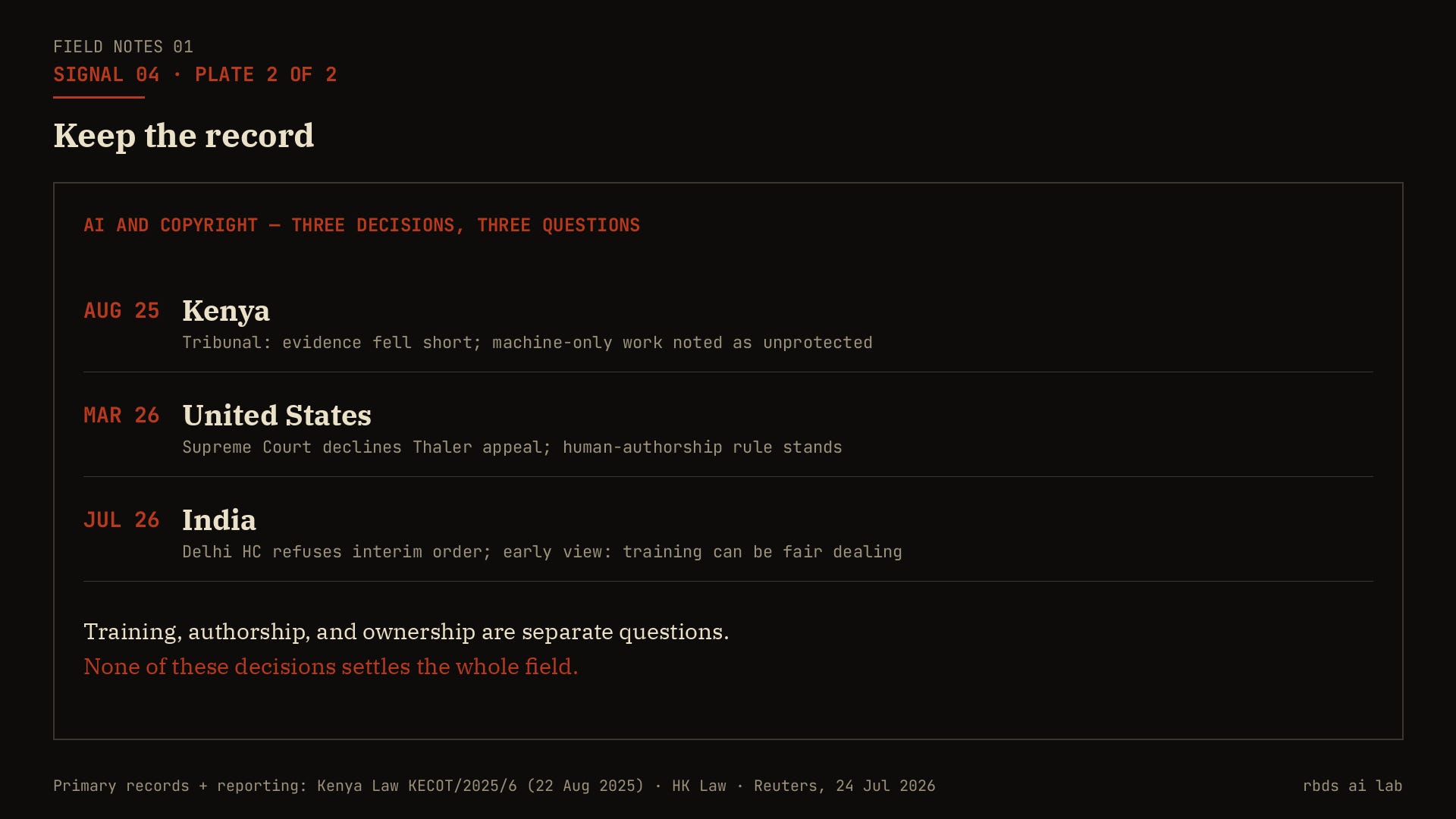
Three decisions on AI and copyright, each answering a different legal question. Credit: Kenya Law KECOT/2025/6; US Supreme Court docket 25-449; Delhi High Court, July 24, 2026.
For a studio, two kinds of record are worth keeping, and they do different jobs. A creative-process record notes the brief you gave, the versions you rejected, and the choices you made, and it may help show human authorship and contribution. A source-and-provenance record notes which tools, models, and reference materials entered the workflow, and it may help show where the ingredients of the work came from. Neither record creates copyright by itself, and neither settles liability. They are evidence for questions the courts are still working out.
At your desk this week: start both records on your current project. Keep one page per deliverable for the process: what you asked for, what you rejected, what you changed, and why. Keep one running list per project for provenance: the tools, models, and reference materials that entered the work.
The direction under the four
Taken together, these four changes describe one direction of travel. Our software is getting better at receiving instructions, answering questions about our own files, and inspecting our documents against rules. None of that moves the responsibility for reasons, choices, and consequences, which stays with the people who sign the drawings. The month’s real work is quiet: learn what the new readers and listeners actually do, put sensible limits around them in the office, and keep the records that show where your judgment entered the work. Next week, this page returns to a longer essay, about what happens when assistants work inside our tools and the environment we set up for them becomes a design problem of its own.
Key Sources
Trimble SketchUp — “Design with Dialogue: Meet the SketchUp Connector for Claude”; “SketchUp Connector for Claude”; and the SketchUp Free commercial-use guidance.
Autodesk — “Fusion Comes to Claude for Creative Work” and “Introducing the Revit Public MCP Server”.
Chaos — Veras official product information and Chaos Credits plan information.
Automated permit review in the United States — the Office of Governor Gavin Newsom on the Los Angeles Archistar programme, and the City of Seattle’s CivCheck study.
Building approval systems in India — official portals of the Brihanmumbai Municipal Corporation, Pune Municipal Corporation, Telangana BuildNow, and the Delhi Development Authority; The New Indian Express on the May 2026 DDA single-window announcement.
Copyright Tribunal of Kenya — Aryeh Movement Limited v Okello, judgment dated August 22, 2025, published by Kenya Law.
Supreme Court of the United States — Thaler v. Perlmutter, Docket No. 25-449, petition denied March 2, 2026.
High Court of Delhi — ANI Media Pvt. Ltd. v. OpenAI, interim judgment dated July 24, 2026.
I’m Sahil Tanveer. I run RBDS AI Lab, where we study what AI is actually doing to architectural practice — through built work, research, and teaching.
The book, the courses, the channels, the free tools, past talks — everything is in one place: rbdsailab.com.
Enquiries: sahil@rbdsailab.com